Late Nineteenth and Early Twentieth Century Fantasy Illustrators

Four centuries after the Gothic Age, technological developments in printing and reproduction provided a ripe opportunity for illustration. These developments, coupled with the growth of the middle class, caused the book publishing indus​try to flourish. This period was known as the Golden Age of Illustration.

The European artists of this time were strongly influenced by the style of Japanese woodcut prints. Other influences such as the Pre-Raphaelites, Art Nouveau, the Arts, and Crafts Movement, and Les Nabis contributed to the strong design elements of many of the illustrations. Walter Crane, Edmund Dulac, Aubrey Beardsley, Arthur Rackham, and Kay Nielsen were some of the most prominent artists of this era.

The Brandywine tradition, founded by Howard Pyle, was the foremost influence on American illustration of this period. Notable American artists of the Golden Age were N.C. Wyeth, Maxfield Parrish, J.C. Leyendecker, Charles Dana Gibson, and Jessie Willcox Smith.

Among the most popular subjects of this period, on both sides of the Atlantic, were fairy tales, folklore, myths, and legends. These subjects were as popular with adults as they were with children and the vivid subject matter allowed illustrators to create fantastic images that melded magic with realism.
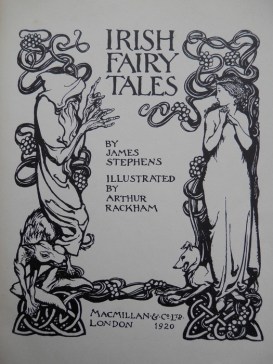
ar1


Arthur Rackham, 1920, watercolor and ink, cover page to James Stephens’ Irish Fairy Tales.

At the forefront of this fantasy genre of literature were the age-old tales from Irish lore and mythology. Rich with legendary accounts of fairies, goblins, witches, and mysterious little men with secret pots of gold, these tales were ideal for the endless imaginations of the days most prominent artists. These stories also provided an opportunity for incorporating the intricate knotwork of the Celtic tradition into the highly stylized compositions which were characteristic of this category in late 19th-century​ illustration.

European Illuminated Manuscripts

Carolingian-1

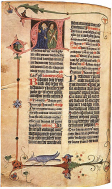
Artist unknown, 15th c., Gothic manuscript, France.

At the time that the Book of Kells was being created in Ireland, another style of illuminated manuscript was developing in continental Europe. This style was known as the Carolingian style and incorporated delicate pen-and-ink figures with a very literal interpretation of the passages of the Psalms. These manuscripts were literally illustrating the biblical stories in a truly narrative fashion.

By the 10th and 11th centuries, the older Anglo-Celtic style was abandoned in favor of the Carolingian style. Artists had become increasingly skilled at integrating illustration, decoration, and text. Although the traditional Celtic style was no longer in fashion, the cohesion of styles that culminated in the progression of the art of the illuminated texts still exhibited the Irish influence.

During the Gothic Age, 13th to 15th centuries, a more realistic style emerged. Figures were now rendered with accuracy and reflected the fashions and architecture of the era. However, the decorative elements still maintained an intricacy of pattern reminiscent of the ancient styles. ¹

¹ Christopher De Hamel, A History of Illuminated Manuscripts, Phaidon Press, London, England, UK, 1997, pages 92-107

Manuscript Materials

Such involved artwork, as that created for the Book of Kells, required a sturdy material to absorb the pigments and sustain the elements of time. Calfskin vellum was used for this purpose. To create the 680 pages of the book, 340 calfskins were cleaned and left to soak in a limewater mixture for several weeks. The skins were then removed from the liquid and scraped to remove any remnants of hair and debris. The skin was then stretched to a fine surface that was then treated and prepared for accepting ink. Most of these inks were made from the juices of the local flora and fauna, the very dark colors being created from oak galls – a growth forming on the bark of oak trees as a result of fungus and insects. The vivid colors of the pigments used in the illustrations were created using several different materials and techniques. There are five central colors used in combination with the dark brown and black inks.

  1. Red – Red lead was used to produce this bright orange-tinged color.  This pigment lay on the surface of the vellum and has flaked off in some areas over the years leaving a white vacant space.
  2. Green – Copper was used to produce the emerald shade of green.  This pigment was absorbed deeply into the vellum seeping through to the other side in some cases.  This is due to the acidity of the metal.
  3. Yellow – Pale colored soil mixed with egg whites was used to produce this golden hue.  The luminous properties of the egg white are what give it its surface sheen, which effectively mimics gold foil.
  4. Purple – Indigo, obtained through trade with northern Europe, was used to produce the rich violet tones.
  5. Blue – Lapis lazuli was imported from Asia to produce the sapphire pigment.

These last two colors, purple and blue, illustrate the flourishing trade industry, which was quickly reducing Ireland’s isolation from the continent. As is customary with any trading system, knowledge and influence is exchanged along with goods and natural resources.​¹

¹ George Otto Simms, Exploring The Book of Kells, The O’Brien Press Ltd., Dublin, Ireland, 1988 pages 26-32.

Text and Image

ChiRo

Artist unknown, 800 A.D., Chi Rho page from the “Book of Kells.”

The monks were seeking to convey Christ’s message through illustration and integrated those illustrations with words to tell the complete story. In fact, some of the more elaborate illustrations are actually extremely ornate calligraphy spelling out the opening phrases of the Gospels that follow them. A fine example of this is The Incarnation Initial (also known as the Chi Rho page). At first glance, it appears to be a decorative design of Celtic knotwork and figures, but is, in fact, a composition of letters that spell out the phrase XPI B GENERATIO (“Now the birth of Jesus Christ”), which are the opening words of the Gospel according to St. Matthew. (1)

Master

Artist un- known, 800 A.D., Letter illustration from the “Book of Kells.”

This unusual use of text as graphic adornment is a common theme throughout the manuscript; however, the monks were equally adept at using imagery to convey the complex messages of the Bible. An example of this is found in an illustration of the capital letter “N” in one section of the text. The letter is constructed of two intertwined men facing each other while tugging on each other’s beards. Their expressions are angry and the little picture is an expressive visual of a struggle. The “N” begins the sentence “No man can serve two masters,” so the illustration serves the dual purpose of being part of the text as well as visually explaining the meaning of the text. (2)

(1) George Otto Simms, Exploring The Book of Kells, The O’Brien Press Ltd., Dublin, Ireland, 1988 pages 48-50.

(2) Carl Nordenfalk, Celtic and Anglo-Saxon Painting, Chatto & Windus Ltd., London, England, UK, 1977, pages 16-19.


The Four Evangelists

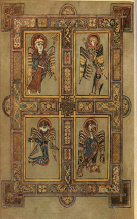
Of the imagery depicted in the Book of Kells, there are some interesting symbolic representations that were adopted from the Book of Revelation, to represent the four Evangelists. They are known as the four beasts of Ezekiel and are depicted as follows:

EVANGELISTS

Artist unknown, 800 A.D., Carpet page of the Four Evangelists from the “Book of Kells.”

The Lion – St. Mark – St. Mark is represented by this symbol due to the emphasis on Christ’s power and loyalty in the Gospel according to Mark.

The Eagle – St. John – St. John is represented by this symbol due to the belief that St. John, the Evangelist soared into Heaven and was able to “gaze upon the light of immutable truth with keen and undazzled eyes.”

The Ox – St. Luke – St. Luke is represented by this symbol due to the emphasis of Christ’s sacrifice in the Gospel according to Luke.

Man – St. Matthew – St. Matthew is represented by this symbol due to the emphasis of Christ’s humanity in the Gospel according to Matthew. (1)

The Book of Kells was intended to be more than just another manuscript of the Bible. To the Monks who created it, it was an homage to Christ and His message. The delicate care with which the carpet pages (2) were created is a testament to the passion and devotion of the artist.

(1) Ben Mackworth-Praed, The Book of Kells,
Studio Editions, Ltd., London, England, UK, 1993, pages 16-17. 14.

(2) Carpet Pages – pages of ornamentation typically placed at the beginning of each of the four Gospels in Gospel Books.

Book of Kells

The Book of Kells, written around 800 A.D., is a book of the four Gospels written and illustrated by monks and was named for the Irish midland monastery of Kells, Co. Meath. The astonishing intricacy of the illustrations in the Book of Kells is a combination of the traditional Celtic motifs and the influence of Saxon decoration brought back to Ireland by missionaries from abroad. Animal forms interlocked with geometric patterns gave birth to the complex intertwining designs that predominate Celtic art from this period forward.

The calligraphy and variety of illustrative styles suggest that several different artisans constructed the manuscript. Scholars, who have studied the manuscript closely, discern that there were several artists who created the animal illustrations and knotwork designs, and a separate portrait painter responsible for the human figures. It is also believed that many of these portraits that are included in the decorations of the pages are actually caricatures of local people. Additionally, there is evidence that there were numerous scribes involved in transcribing the text. It has been narrowed down to four distinctive calligraphic styles with the following attributes:

1. Scribe A – Unadorned calligraphy.

2. Scribe B – Unadorned calligraphy with different colored inks.

3. Scribe C – Limited use of decoration in combination with calligraphy.

4. Scribe D – Extensive use of decoration and script.

scribes

Many of the designs incorporated into the text served purposes beyond mere decoration. For example, there are a few instances where the foot of an animal serves as a hyphen and other examples where feet, tails, and flowers are used as punctuation marks. (1)


(1) The Book of Kells – The Work of Angels? , Kultur Video, West Long Branch, N.J., 2000

Integration of Catholicism and Mythology

St. Patrick understood the powerful hold of the pagan beliefs of the Irish people. He, therefore, realized that he could not annihilate those ideas from the hearts and psyche of this unique culture. Instead, he devised a system that integrated the concepts of Christianity with the already existing beliefs. The result was a distinctive form of Catholicism that remains a very exclusive entity to this day.


St, Brigid


St. Brigid’s Well, Co. Kildare, Erin Brierly, September 5, 2007

Many of the pagan deities were integrated with Catholic saints. For example, Brighhid (old Irish spelling), the primary Mother Goddess of Ireland, was incorporated into the Christian St. Brigid, who along with St. Patrick is one of the patron saints of Ireland. Today in Ireland there are still many springs and wells named after Brigid. Water is believed to be a portal to the Otherworld and is also thought to be a source of wisdom and healing. Offerings of coins are thrown into the wells in the hopes of being granted a reward from St. Brigid. This is the forerunner of the modern custom of tossing a penny into a fountain while making a wish. (1)


Along with the evolution of these customs to align themselves with Christianity, came the reinvention of the Celtic artwork. The art of this period included chalices, shrines, crosses and most notably illuminated manuscripts. At this time, the monastic system became the center of the Celtic art world. The monks were among the most skilled calligraphers in Europe and developed masterworks of Insular illumination. (2) The manuscript that depicts the pinnacle of this golden age of Celtic art is undoubtedly the Book of Kells.

(1). James Bonwick, Irish Druids and Old Irish Religions, Barnes and Noble, Inc., USA, 1986, pages 238-244.

(2). Insular Illumination – a medieval script system used in Ireland and Britain (Latin: insula, “island”).

St. Patrick

The arrival of St. Patrick to the shores of Ireland dramatically changed the course of the indigenous culture and its art.

Contrary to popular belief, St. Patrick was not Irish. He was a Roman Britain, who was enslaved by Irish raiders and kept in captivity in Ireland for six years. He eventually escaped and returned to his home where he entered the Church and became a bishop. He believed it was his destiny to return to the Irish people and save them from their pagan ways.(1)

He is most famously known for driving the snakes out of Ireland. However, it is most likely that snakes never existed in Ireland due to its climate and its isolation from continental Europe. It is more likely that the snake represents the symbolism of the Druids and therefore the story relates to the country’s conversion from paganism to Christianity.

Another legend associated with St. Patrick tells of his use of the shamrock to describe the concept of the Holy Trinity. He used the structure of the plant, which has three leaves and one stem, to represent the idea of three beings in one God, the Father; the Son; and the Holy Spirit. This one example of symbolism has probably become the most potent icon of Irish representation the world over. But it is also a testament to the cleverness of St. Patrick in his efforts to convert the Irish pagans.

(1) James Bonwick, Irish Druids and Old Irish Religions , Arno Press, New York, N.Y., 1976, pages 27-29.

Early Celts

The Celts arrived in Ireland around 500 B.C. They were an Iron Age culture that archeologists believe originated in central Europe. The Celts were an intelligent race with a thirst for knowledge. These qualities enabled them to assimilate into and fuse with the races they conquered easily. In the early Middle Ages, the Irish Celts were amongst the most noteworthy pioneers in exploration, science, philosophy, and religion. Their legacy of learning is in part responsible for earning Ireland the moniker “The land of scholars and saints.”(1)

The Celts brought with them a primitive alphabet known as ogham.


ogham

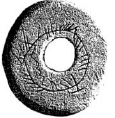
Photographer   unknown, Date unknown, Inscribed spindle-whorl from Buckquoy, Orkney (Crown copyright: Institute of Geological Sciences, NERC)

This alphabet consisted of twenty characters, known as feda, which are separated into four categories, known as aicmi. A different carving in the stone or wood represents each aicmi. For example, the letters B, L, S, F, and N are represented by downward strokes, while the letters H, D, C, T, and Q are represented by upward strokes. The letters M, G, NG, Z, and R are represented by perpendicular strokes, and the vowels A, E, I, O and U are represented by notches. The angled strokes and notches cross a centerline forming a pattern reminiscent of the circular and spiral designs of the traditional art. (2)


knotwork

Sheila Sturrock, 1997,  “Celtic Knotwork Designs.”

The artistic expression and decoration of the Irish remained somewhat primitive until the arrival of the Celts. Early Celtic art introduced more sophisticated “Celtic Knotwork Designs.” geometric figurations based on circles, spirals, and curved lines. These advances in design culminated in the intricate knotwork that has become synonymous with Celtic art, an art form that would flourish into its “Golden Age” after the advent of St. Patrick and the Irish conversion to Christianity. (3)

  1. T.W. Rolleston, Celtic Myths and Legends, Studio Editions Ltd., London, England, UK, 1996, pages 35-39.
  2. Dr. Barry Fell, “The Ogam Scales from the Book of Ballymote,” ESOP Vol. 22 pgs. 87- 133, The Dawson Library, 1993.
  3. T.W. Rolleston, Celtic Myths and Legends, Studio Editions Ltd., London, England, UK, 1996, page 21.

Bronze Age

Ireland’s Bronze Age dates from around 2000 B.C. until the arrival of the Celts in 500 B.C.  During this time Irish art takes on a distinctive style.  Ireland, being on the edge of Europe, was not as exposed to the influence of the Mediterranean as continental Europe was.    As such, the artistic influences remained contained within the island’s own heritage. The Irish design styles in the Bronze Age period are very similar to the Neolithic patterns and motifs found in the stone carving of that period. There are examples of this on artifacts such as the Petrie Crown, which includes a variation of the triskele.

Bronze1

Photographer unknown, Date unknown, “Petrie Crown,” first century A.D.

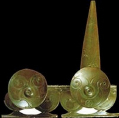
During this period, bronze was used to manufacture many different items ranging from weapons to adornments.  The Irish used clay molds to cast the bronze into different shapes.  Several examples of flat axes and swords survive to this day. However, the largest collection of Bronze Age musical instruments hails from Ireland with a total of 104 horns and 48 bells.(1)

Bronze2

Photographer unknown, Date unknown, Bronze Age Horns

At this time, Ireland had a thriving goldsmith trade, and many ornamental objects found their way to Britain and continental Europe.  Gold proved to be an ideal surface for embossing the intricate designs such as the concentric circles, hatched triangles and the spirals unique to the Irish artwork of the time.  The craftsmen of this time became so adept at this technique that the complicated workmanship is nearly impossible to replicate today.


1. Seamus, Mac Annaidh, Irish History – Micropedia, Parragon, Bath, England, UK