Portraits of the Evangelists

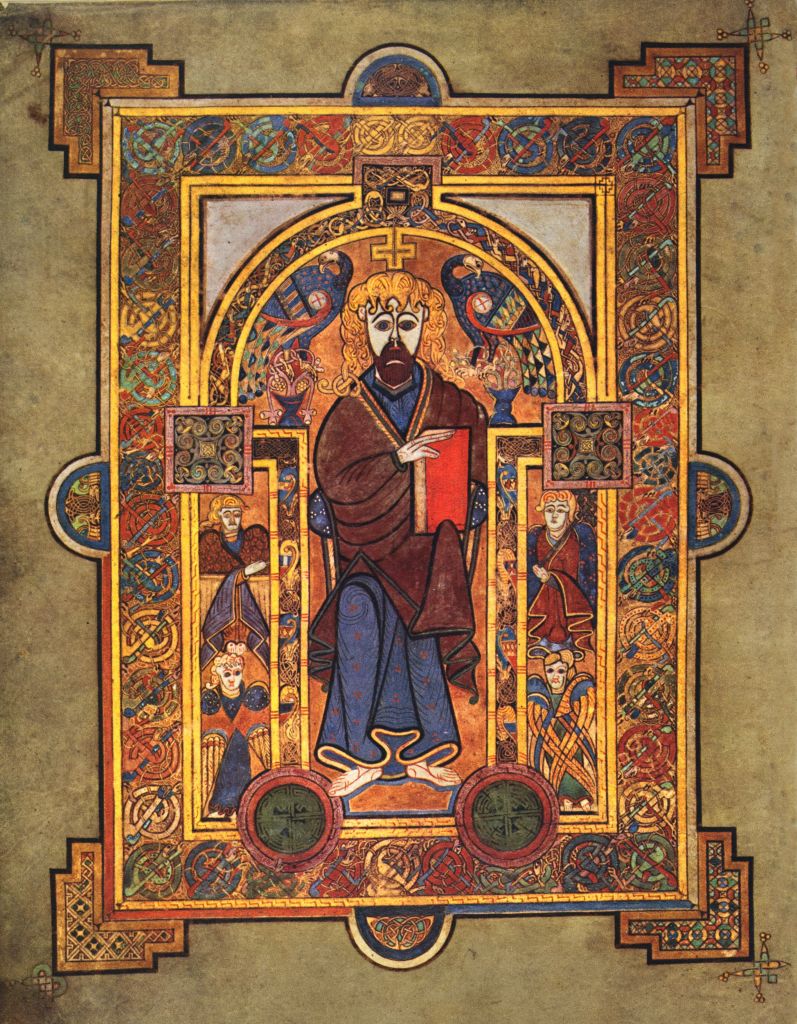
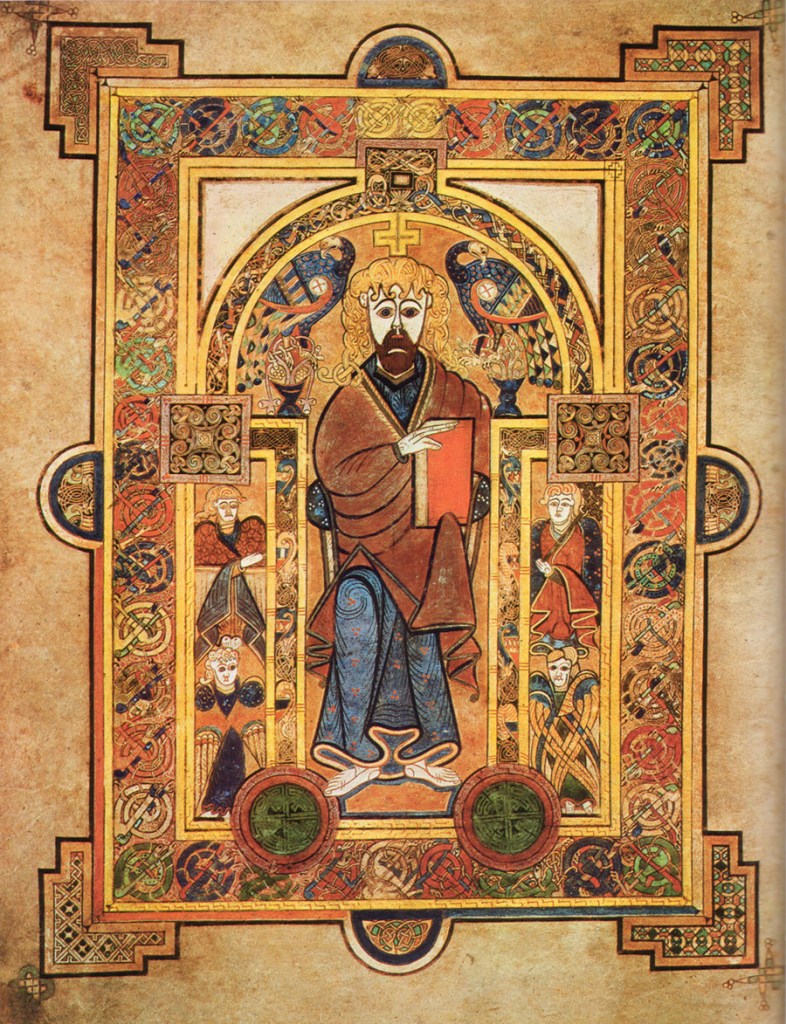
There are only two full portraits of the evangelists in the Book of Kells. One of John and one of Matthew at the commencement of their Gospel texts. The remaining Gospels of Mark and Luke begin with intricate illuminations introducing their testaments without the inclusion of author portraits.

At the start of the Gospel of Mark, folio 129v depicts the symbolic representations of the four evangelists, but this should not be confused with an author portrait. Iterations of this imagery also appear in the Gospels of John and Matthew.

Continuing the conversation regarding the symbolic use of color in the Book of Kells, it is interesting to compare the evangelist portraits with the portrait of Christ discussed in the earlier post.

As we can see, both John and Matthew gaze out toward the viewer in a similar pose to Christ’s. However, there are key differences that distinguish them from the realm of the Son of God. To begin with, both of the evangelists have halos, where Christ has a cross extending from his head. The garments of the two evangelists consist of a red robe, similar to Christ’s. However, the tunics beneath their robes are muted earth tones rather than the blue of Christ’s tunic, grounding them in humanity (red), distinguishing them from the divine (blue) nature of Christ.

The treatment of the hair and beards in the portraits of John and Matthew is also interesting to examine. Both of the evangelists have fair hair with slightly darker reddish-brown beards. This color combination is also evident in the portrait of Christ but with heightened dramatic contrast. The gold of Christ’s hair is much brighter, and the reddish-brown of the beard strikingly darker. As compelling as this artistic choice is to investigate in terms of symbolic coloring, we must also consider the possibilities of other reasons for its occurrence, such as fading due to age, as well as the probability that several different hands created these images.
Spiritual Significance of Color in Early Christian Art

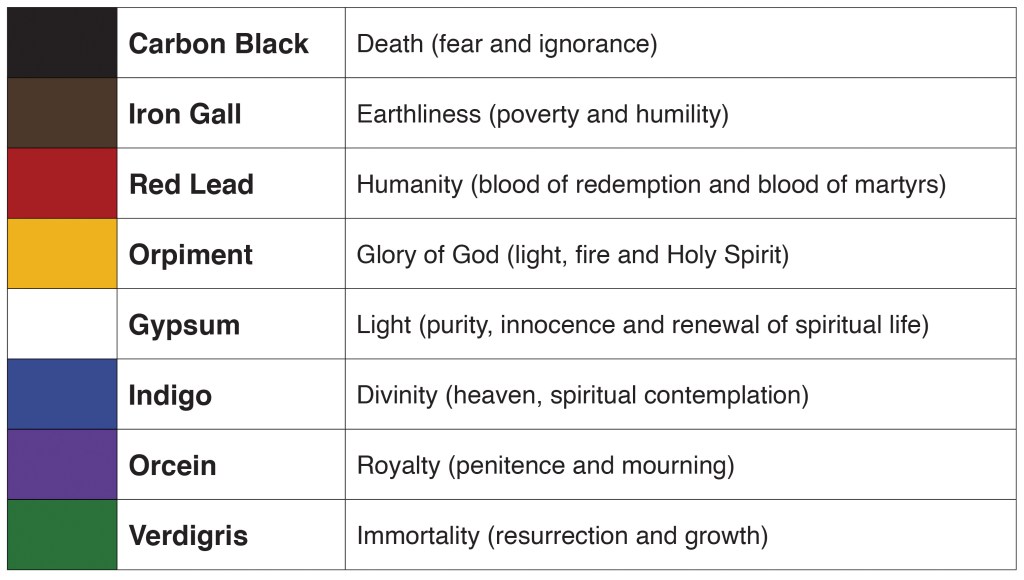
In early Christian art, the symbolic meaning of color was significant for expressing the characteristics of the portrayed figures. As an essential element in iconography, each color represented specific traits or properties attributed to the depicted icons and elements. These notions of symbolic colors were widely used but not inflexible. Often artists rendered their interpretations of the canons of iconography, resulting in representations that varied according to region, culture, and period.

In the Book of Kells, for example, eight-core pigments have been identified. Below is a chart listing the pigments with their corresponding iconographic values.

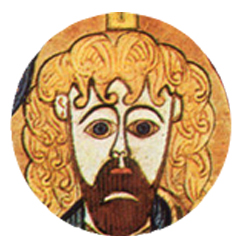
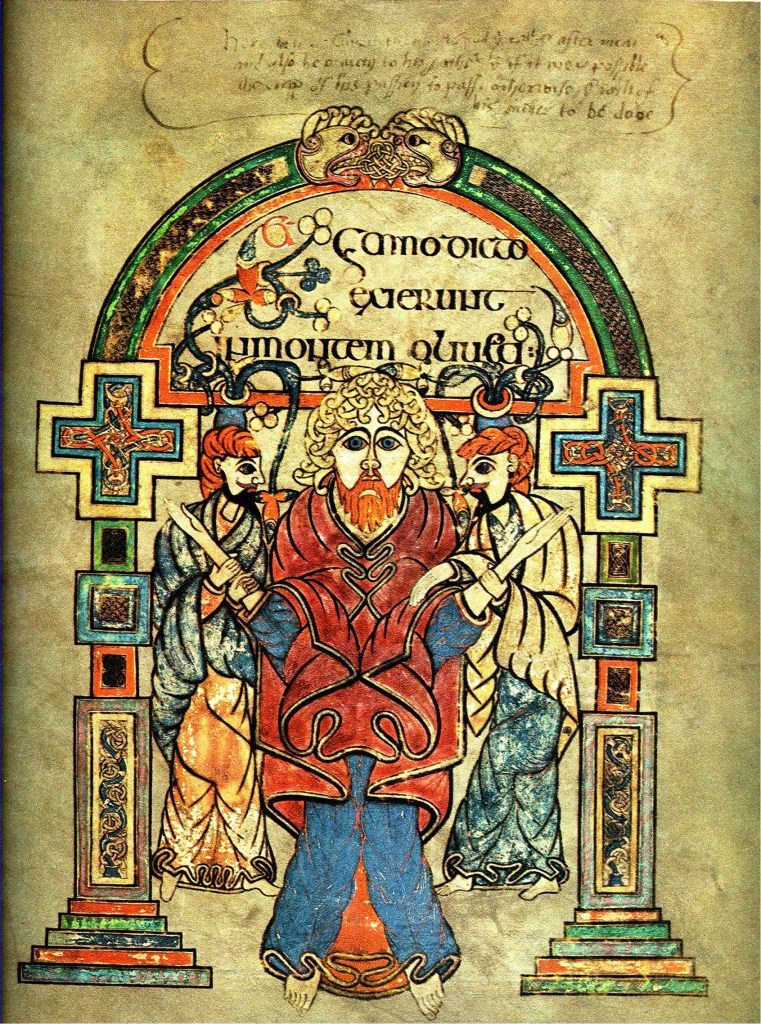
It is interesting to question the intent of the artisans of the Book of Kells while taking note of the varied use of the tenets of color symbolism in these two images of Christ. Here, the artists chose to depict Christ with fair hair and a reddish-brown beard.

One way to begin a potential analysis of this artistic choice is to examine the texts these images illustrate. Both of these images appear in the Gospel of Matthew, whose opening line in the Vulgate reads:

Liber generationis Jesu Christi filii David, filii Abraham. (The book of the generation of Jesus Christ, the son of David, son of Abraham.)

Matthew 1:1

1 Samuel 17:42 describes David as having reddish hair, so perhaps the auburn beard of Christ references Matthew’s assertions of Christ’s adoptive lineage to David through Joseph. Nevertheless, this does not explain the fair hair on his head. There are no physical descriptions of Jesus in the Gospels; however, in Matthew 17:23, the transfiguration of Christ provides the following description:

et transfiguratus est ante eos. Et resplenduit facies ejus sicut sol (and he was transfigured before them. And his face shone as the sun)

Matthew 17:23

Perhaps then, the golden yellow hair of Christ in the Book of Kells is symbolic of the Glory of God, therefore, representing the duality of Christ’s human and divine incarnations. As we can see, His costume consists of a blue tunic with a red robe which further signifies His divinity and humanity.

However, for this analysis to be considered a viable resolution, Christ would need to be the only figure in the book depicted with these traits, consistently discerning Him from any other persons. Further investigation of the illuminations is necessary for constructing this argument.

Sources:

“The Book of Kells.” The Book of Kells – The Library of Trinity College Dublin – Trinity College Dublin. Accessed April 22, 2021. https://www.tcd.ie/library/manuscripts/book-of-kells.php. https://doi.org/10.48495/hm50tr726

“Internet Sacred Text Archive Home.” Internet Sacred Text Archive Home. Accessed April 22, 2021. https://sacred-texts.com/bib/vul/index.htm.

Ancient Irish Trade Routes

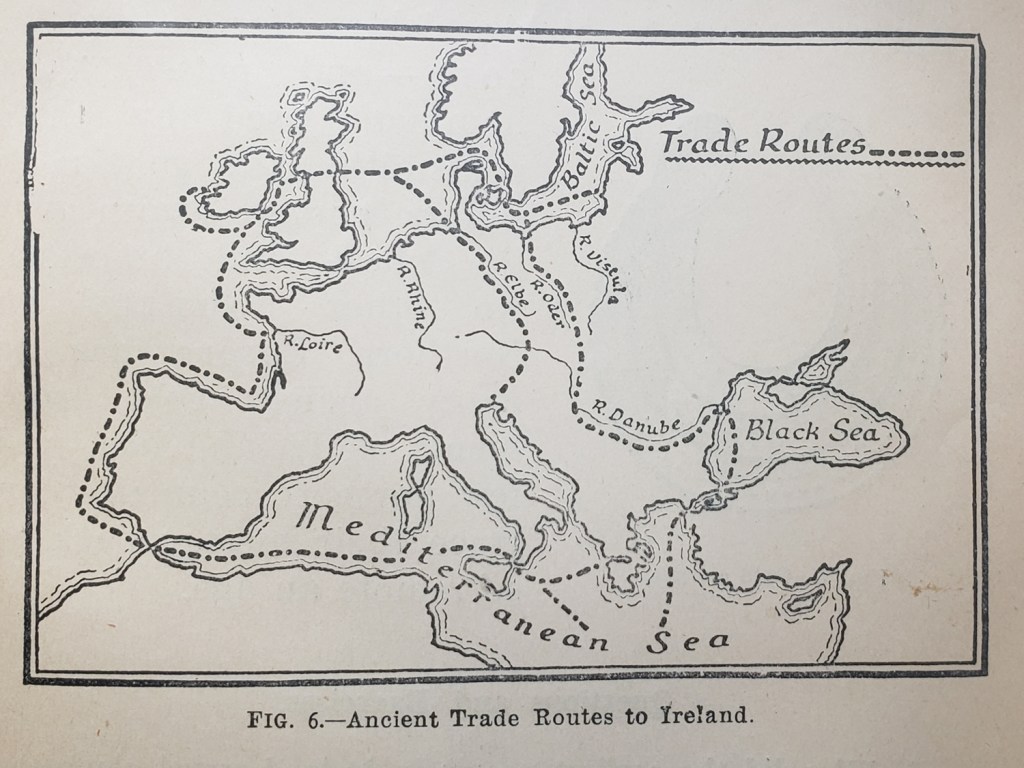
Archaeological evidence has noted that merchants brought commodities such as tin and amber to Ireland in the first millennium BCE., suggesting extensive trade routes that connected Ireland to neighboring Britain and the faraway lands bordering the Baltic Sea. Long-established links between Britain and Armorica (modern-day France) trace back to the third millennium B.C. where a broad trade network connected the two territories. In roughly the same period, the Romans established the Amber Road linking Northern and Southern Europe to the Balkans. These prehistoric trade routes were vital to the connection between the remote island of Ireland and continental Europe.

One such route extended from the tin mines in southwest Britain, over the English Channel into France, continuing down to the Mediterranean Basin. Exotic artifacts such as amber, gold, and coral discovered at ancient hillforts along this thoroughfare, suggests that these sites served as trading posts. Commerce flowed in both directions along this route resulting in exchanges of technologies, artwork, and ideas alongside material goods.

These essential trade routes crossed religious, cultural, and political boundaries, helping shape the iconography of Insular art in the early medieval period.

Sources:

De Navarro, J.M., “Prehistoric Routes between Northern Europe and Italy Defined by the Amber Trade”, The Geographical Journal, Vol. 66, No. 6 (December 1925), pp. 481–503.

Muhly, J.D, Copper and Tin: the Distribution of Mineral Resources and the Nature of the Metals Trade in the Bronze Age, Hamden: Archon Books, (1973).

Coptic Connection

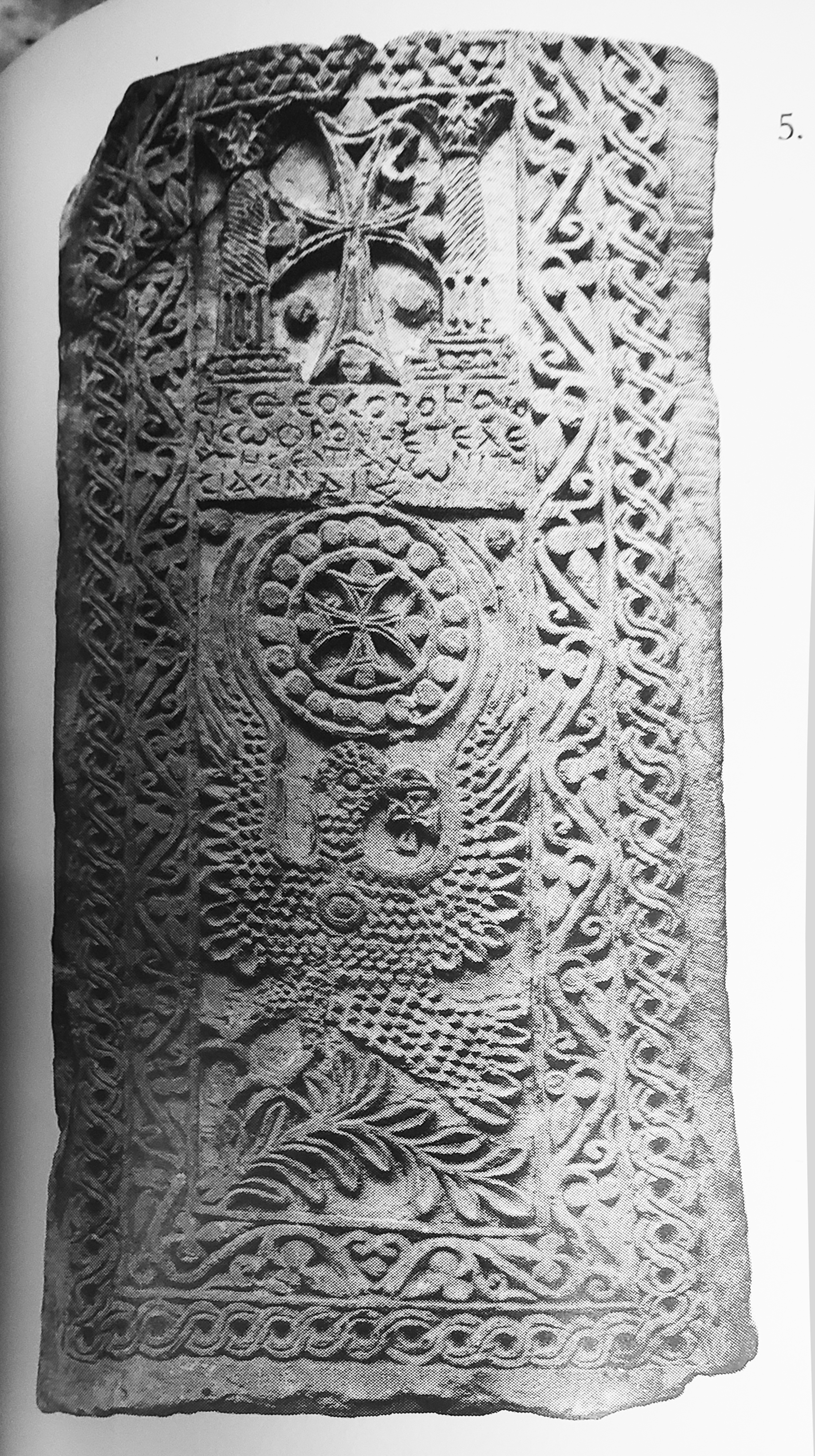
The connection between the iconographic styles of Coptic and Celtic art extends beyond the scrollwork so readily identifiable, particularly in the Insular manuscripts. Composition and figural representations also bear considerable similarities.

Early Coptic Christian icons are discernible by indicative features such as sharp outlines, flat colors, simplified shapes delineating folds in fabric and facial features, without concern for realism. One of the most prominent features of the style was the eyes of the figures portrayed. The eyes are large and do not seem to gaze upon the viewers but beyond and past them. This deliberate artistic choice is symbolic and carries a meaningful divine message, as do many other aspects of the facial features in Coptic iconography. For example, the eyes were rendered large and with simplistic shapes to symbolize the ability to look beyond the material world to transcend into the light of God. Similarly, the artists diminished the nose and mouth to deemphasize sensuality and ill words while enlarging the ears to emphasize the importance of listening to the word of God. (1)

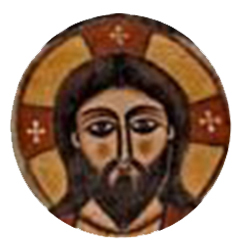
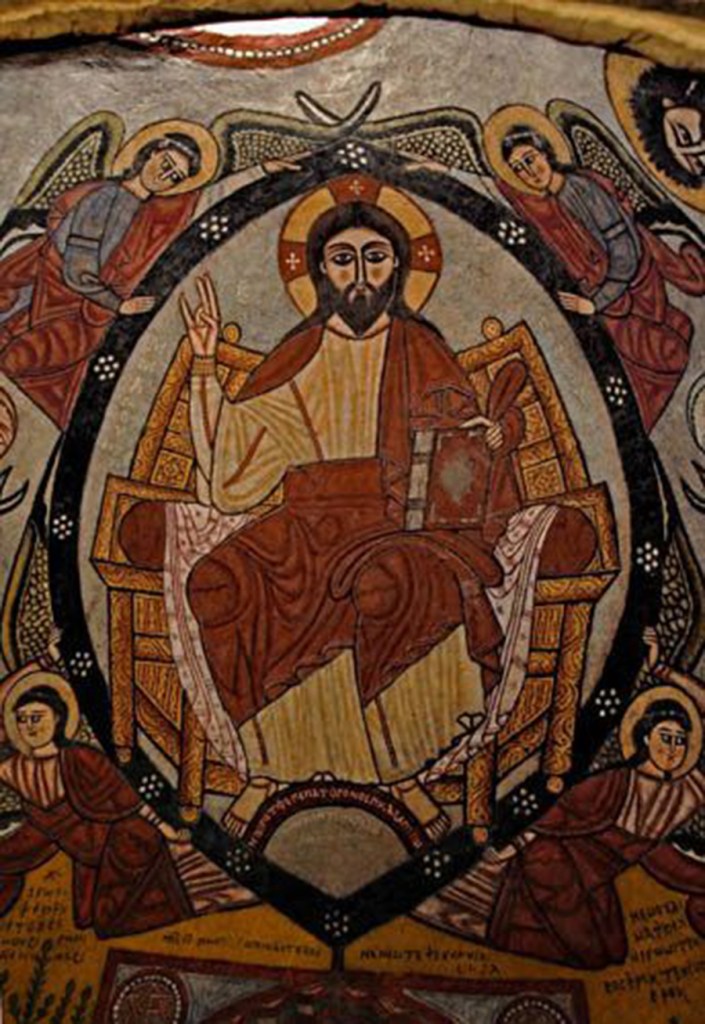
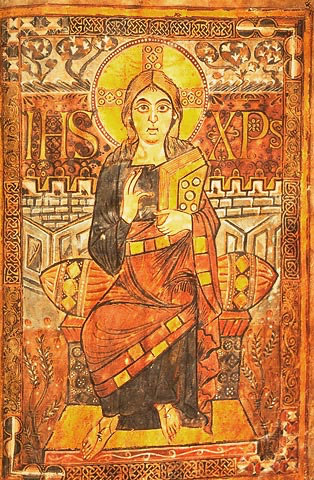
Many of these characteristics appear in images outside of the Coptic Church. Indeed they can be found in the Book of Kells (early 9th-century) illuminations. Although the imagery in the Book of Kells has become somewhat more ornate, the facial attributes in the figures seem to emulate the Coptic traditions of form. For example, the face of Christ in folio 32v from the Book of Kells bears a striking resemblance to the visage of Christ in the 7th-century wall painting from St. Antony’s Monastery in the eastern Sahara Desert of Egypt.

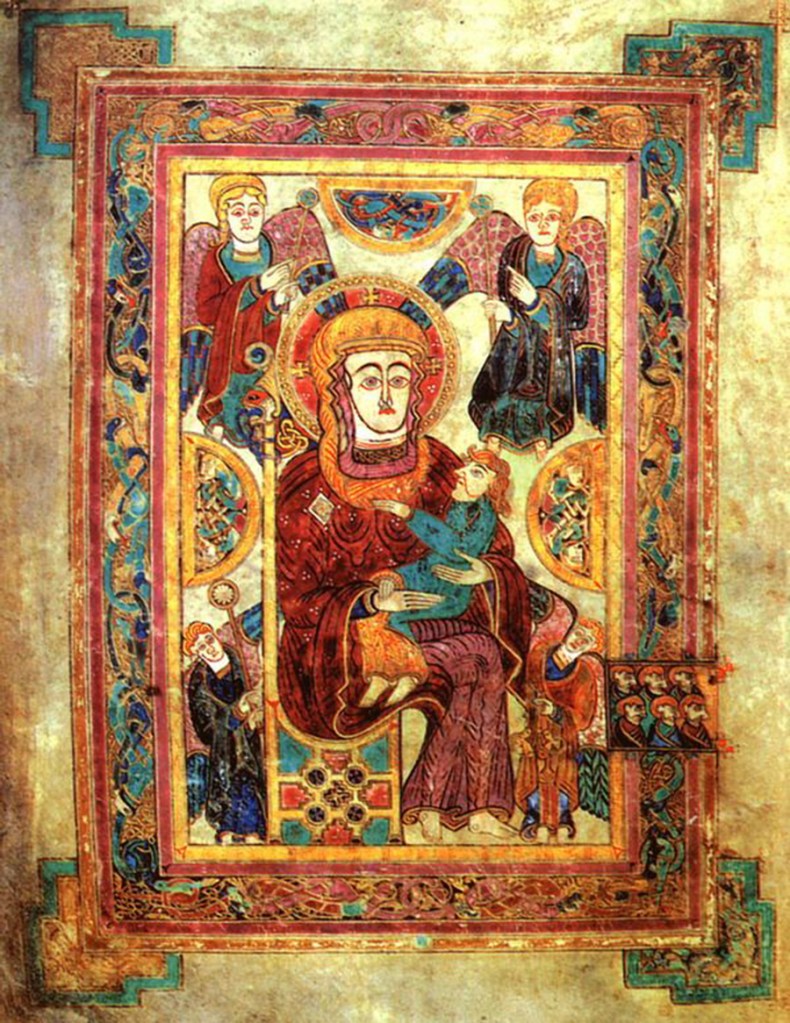
These examples also seem to be following in Coptic traditions of composition. Below, the central figure of Christ from the Egyptian wall painting is enthroned and surrounded by four angels. Likewise is the illumination of the Madonna from the Book of Kells (folio 7v). In this comparison, the Coptic Christ is presented as “Pantokrator”—holding the new testament in his left hand while making a gesture of blessing or teaching with his right. The angels flanking him represent the Seraphim and Cherubim, who praise Him as the incarnation of God. Thus, these angels also flank the Madonna and Child to emphasize that the divine child in the Virgin’s lap is Christ the Lord. (2)

The image of Christ enthroned from the Book of Kells is also a curious interpretation of Christ as Pantokrator. Here Christ holds the Bible in His left hand, but although He presents His right hand in a gesture of blessing, it is placed upon the book rather than held up toward the viewer. Perhaps this is to signify the sanctification of the word of God or to bless the sacred Book of Kells itself.

The similarities between the Christian imagery from these geographically disparate lands are compelling. So how did these iconographic ideas reach the distant shores of Ireland?

(1) Capuani, Massimo, and Otto Friedrich August. Meinardus. Christian Egypt: Coptic Art and Monuments through Two Millennia. Collegeville, MN: Liturgical Press, 2002.

(2) Sawires, Dr. Paula. “Coptic Iconography and Orthodox Theology.” Egyptian Christian Art (blog). Accessed March 3, 2021.

The Genesis of Celtic Art

The origin of Celtic art in early Europe lay in merging several diverse styles into something unique and distinctive. Superimposed upon the indigenous Hallstatt decorative techniques (primarily a geometric style with contrasting colors and textures) was the art of the classical world of Graeco-Etruscan models, which made their way into the household of the Celtic chieftains by way of bronze artifacts acquired through trade.

A third influence came from the East, where a Persian style of animal art merged with Greek and Scythian art forms and migrated west, finding its way into the courts of the Celtic aristocracy. By the end of the 5th century, the merging of the three styles results in the earliest manifestation of a genuinely Celtic art known as the Early Strict Style.

By the 6th century in Ireland, the southern half of the country was more culturally progressive than the North, partly because of contact with Gaul, particularly with Aquitaine, where goods would be traded and brought back to Ireland. This relationship would continue through the following centuries with expanding exposure to artwork from farther reaches of the Christian world.

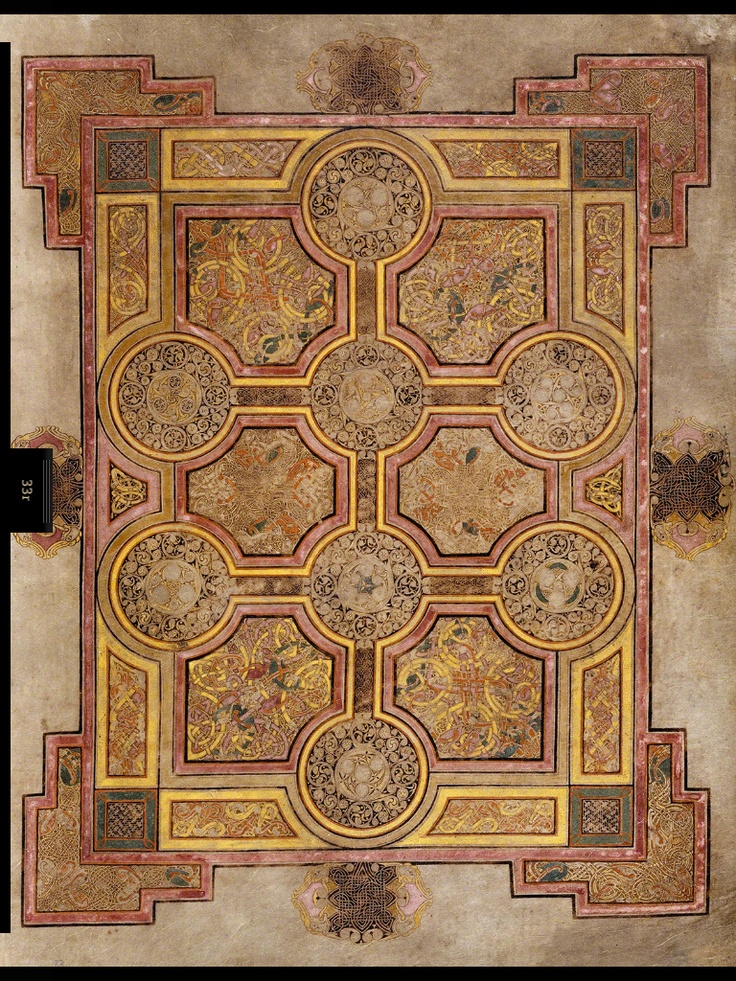
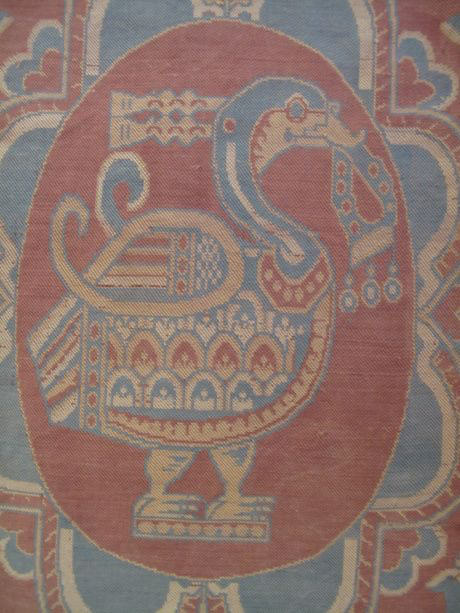
In the first millennium, the art of Ireland is an amalgamation of pagan Celtic themes and Christian iconography, which absorbed considerable influences from cultures as far away as Egypt. Coptic art greatly influenced later Christian art, particularly noticeable in the artwork of the Gospel books produced in England and Ireland beginning in the 8th century. Patterns of clawed birds among vine scrolls merged with animal shapes and interlaced lines of Celtic heritage, creating the images we now classify as distinctive medieval Irish art.

Sources:

Munro, Eleanor C. The Encyclopedia of Art. New York, NY: Golden Press, 1965. Fourth Printing

Cunliffe, Barry W. The Celtic World. New York, NY: Greenwich House, 1986.

What is “Irish” Art?

The art of the ancient Celtic tradition has endured for over 5,000 years. It has evolved from simple primitive markings into the most complicated and sophisticated designs and imagery. Much like the Celtic people themselves, the artwork has adapted and assimilated with the changing times yet somehow always managing to retain its distinctive identity.

When most people think about Ireland, they conjure up images of leprechauns and shamrocks. However, these are very modern icons that have been distorted from their true origins.

There are many conventions stemming from ancient Irish tradition that have melded into our present-day cultures, only they are not readily recognized as being Irish. Most of the traditions of our major Christian holidays actually have their roots in the old Gaelic pagan religion. All of the symbols of these celebrations from the Easter egg to the Christmas tree can be traced back to the druidic rituals of pre-Christian Ireland. Even the tradition of the “honeymoon” derives from the customs of the Irish pagans.

The same can be said in regards to the knotwork designs. Most people have been exposed to this imagery without being aware of its cultural foundation.  However, are these designs exclusively Irish?

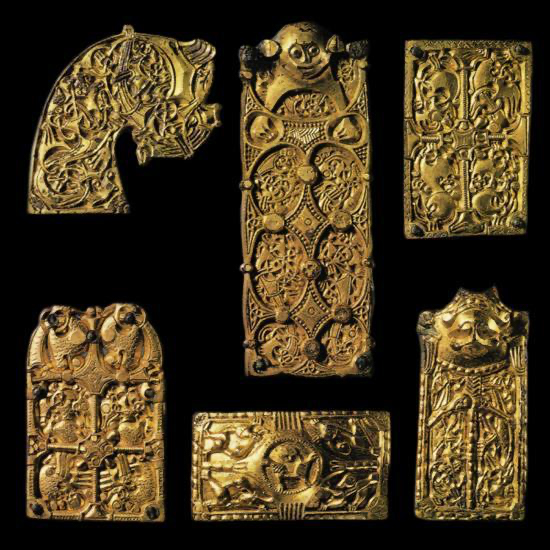
Early Celtic design elements share much in common with early Norse and Germanic art and may even share influences with Eastern European and Asian art from the 7th – 10th centuries.  Any casual visual analysis of artifacts from these diverse cultures appears to reveal commonalities.  If this statement were to prove accurate, it would raise an abundance of questions. Not the least being, which came first?

J. C. Leyendecker (1874- 1951)

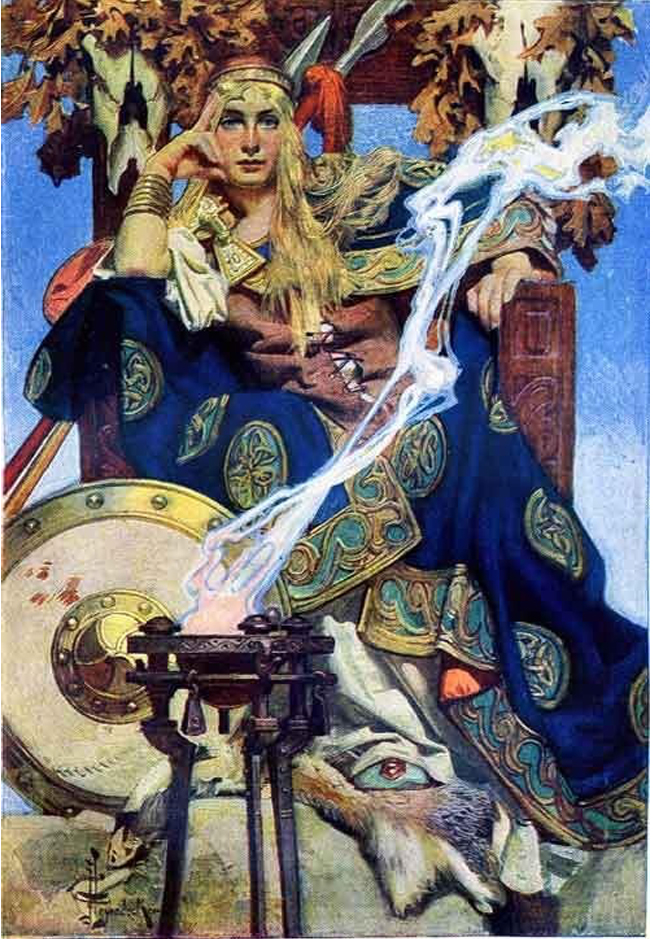
Maeve

Fig. 1, J.C. Leyendecker, 1907, “Queen Maeve,” Magazine illustration.

The Celtic influence during the Golden Age of illustration was not confined to Europe. In
January of 1907, Theodore Roosevelt wrote an article entitled “The Ancient Irish Sagas”
for The Century Magazine, which featured two illustrations, by J. C. Leyendecker (1874-
1951).¹

The first of these illustrations is Queen Maeve, the proud warrior-queen of Connaught. In this painting, Leyendecker captures the cool confidence of this inimitable woman in the bored expression on her face. All of the power and strength of the Celtic warrior is evident in her posture, and her costume and weaponry are accurate renderings of the Celtic design.

The lure of the rich legends of Ireland to both writers and illustrators is not surprising. Depictions of these tales have evolved from a long history of vivid imagination and evocative design. A history that continues to this day.

¹ Paul Giambarba, 100 Years of Illustration and Design, “J.C. Leyendecker”, May 26, 2007.

John Duncan

Jihn-Duncan-1

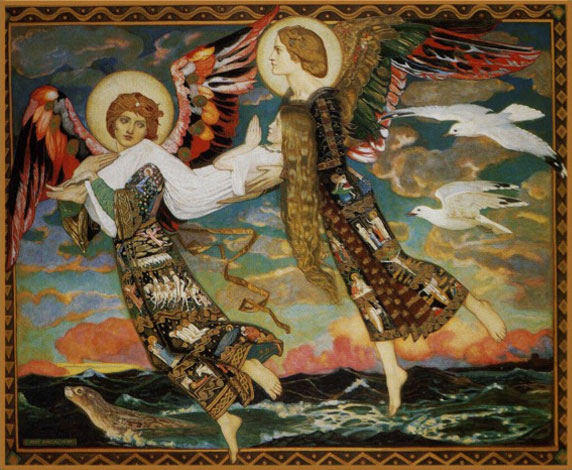
Fig. 1, John Duncan, 1913, “St. Bride,” Tempera on canvas.

One illustrator of this time period that stands out for his passion for this subject matter is Scottish artist John Duncan (1866-1945). Duncan was born in Dundee, Scotland, and began studying at the Dundee School of Art when he was eleven years old. He regarded himself as a mystic and confessed to hearing ‘fairy music’ while he painted.

His artwork was rooted in the Celtic Revival and the Pre-Raphaelite tradition. He worked predominantly in tempera, deliberately mimicking the styles and techniques of the creators of the Irish illuminated manuscripts.

A great example of this is his painting, “St. Bride” (1913). This painting depicts the legend of the Irish Saint Bride as she was miraculously transported to Bethlehem to attend the nativity of Christ. In this work, Duncan’s affinity for the illuminated manuscripts of Ireland is most pronounced. The robes of the angels are richly decorated with Celtic knotwork and the colors are matched to the five major pigments used by the monks in the Book of Kells.¹

John-Duncan-2

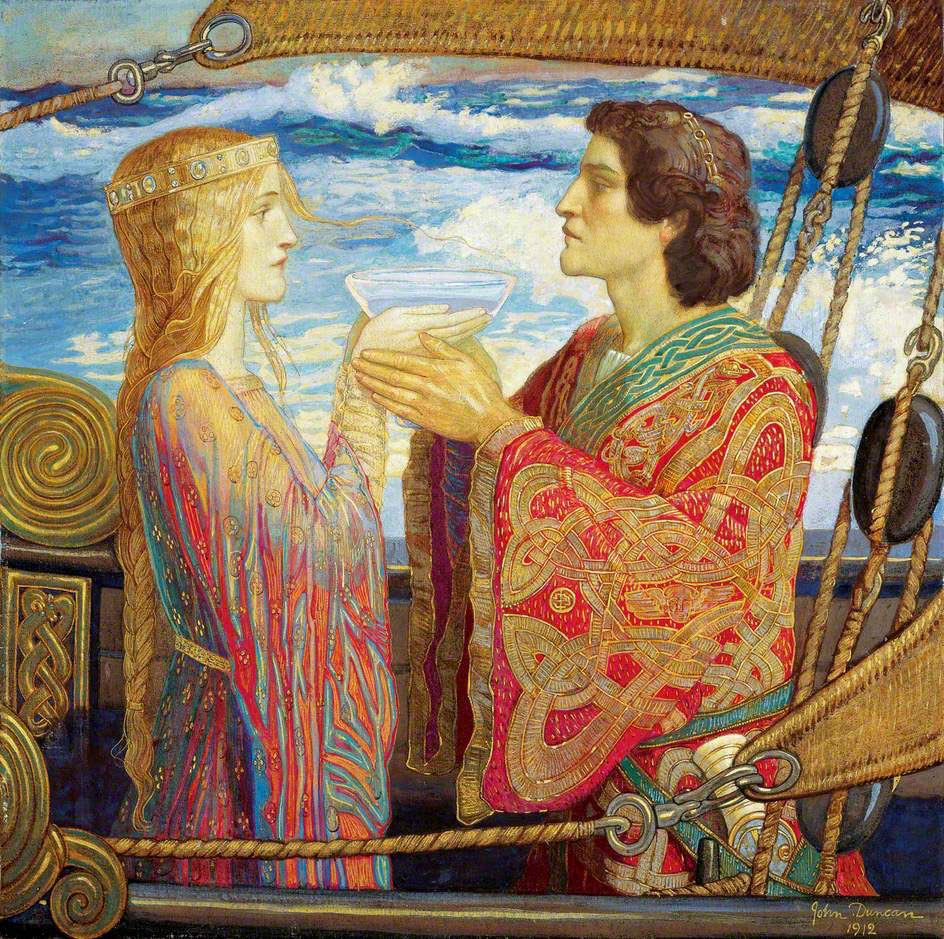
Fig. 2, John Duncan, 1912, “Tristan and Isolde,” Tempera on canvas.

One of his most famous works is the illustration Tristan and Isolde (1912). Tristan and Isolde illustrates the Irish myth of the same name, which is about a young man who is escorting a young woman to Ireland in order for her to marry his uncle, the King. During the journey the two youngsters fall in love after drinking a love potion, resulting in disaster. This work is done in the style of the Pre-Raphaelites but has the distinctive Celtic patterns in the embroidery of Tristan’s costume and the carvings of the boat.

¹ John Kemplay, The Paintings of John Duncan: A Scottish Symbolist, Pomegranate Communications, Petaluma, CA, 1994, pages 40-43.

Harry Clarke

HC-1

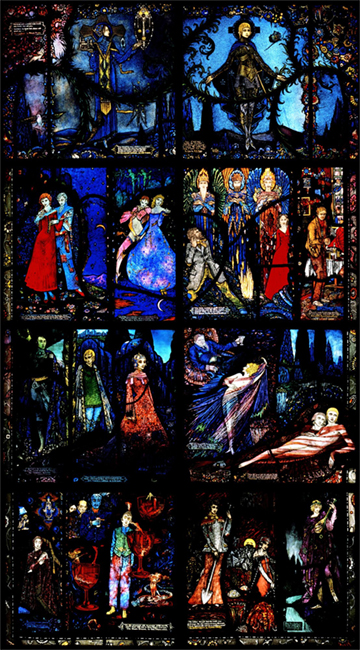
Fig.1, Harry Clarke, 1930, “Geneva Window,” stained glass window, 71½” x 40,” The Wolfsonian–Florida International University, Miami Beach, Florida.

Another artist famous for his depictions of Irish mythology and folklore was Harry Clarke (1889-1931). Born in Dublin, he was a prominent figure in the Irish Arts and Crafts Movement. He made his reputation as a book illustrator but is best remembered for his stained glass windows.

The Arts and Crafts movement triggered a resurgence of Irish art. Clarke designed fabrics and handkerchiefs, boxes and lanterns, but primarily he designed windows. Clarke designed and crafted more than a dozen windows for memorials, churches, and private commissions. These were often interpretations of poems or ballads based on Irish legends.¹


¹ Brigid Peppin, Fantasy, The Golden Age of Fantastic Illustration, Carter Nash Cameron Ltd., New York, New York, 1975, pages 21-22.

Arthur Rackham

One of the most popular artists of the Golden Age of illustration was Arthur Rackham (1867-1939). Rackham, a student of the Lambeth School of Art, possessed a distinctive ability to exemplify the mysterious and often dark themes of the folk stories he illustrated. One way he accomplished this was through his limited use of color, primarily faded browns, muted blues and greens, and misty grays and purples. Rackham’s technique of applying transparent watercolors over finished ink drawings further fashioned an ethereal quality to his artwork.

ar2

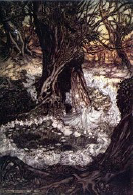
Fig. 1, Arthur Rackham, 1915, “Come now, a roundel and a fairy song,” watercolor and ink, illustration to William Shakespeare’s A Midsummer Night’s Dream.

A distinctive characteristic of his illustrations was his writhing trees and tempestuous landscapes. The natural elements were as alive as the figurative subjects in his paintings. This reflected the ancient idea of tree-animism, which was a fundamental aspect of Irish folklore and myth and paralleled the nature worship of the Celtic pagans.¹ Rackham is perhaps most famous for his fairy illustrations. Many artists of this time were illustrating this popular theme, but Rackham’s treatment of these creatures of fantasy was directly influenced by the Irish tradition of the “little people.”

Along with his fairy illustrations, Rackham also illustrated other figures and themes from Irish mythology. His most prolific work in this genre was his illustrations for Irish Fairy Tales by James Stephens (New York: Macmillan, 1920.)

ar3

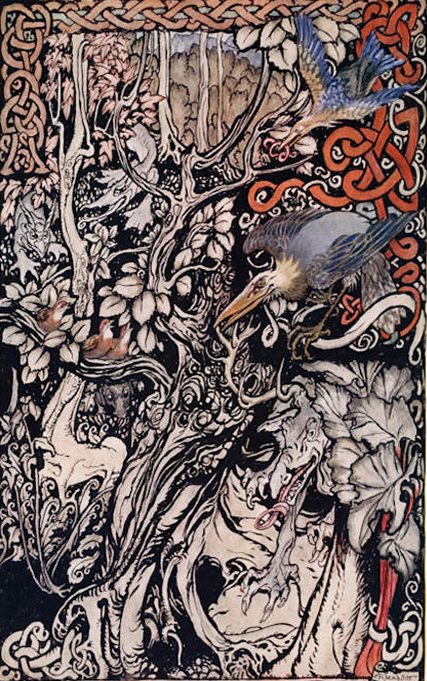
Fig. 2, Arthur Rackham, 1920, “Wild and shy and monstrous creatures ranged in her plains and forests,” watercolor and ink, illustration for Irish Fairy Tales.

Gracing the pages of this book are some of the richest examples of Rackham’s moody and sinister style. One of the best examples of this style is in the illustration entitled “Wild and shy and monstrous creatures ranged in her plains and forests.” In this painting, Rackham intertwines the figurative elements of the story with intricate Celtic-inspired knotwork. The result is a wild entanglement of nature, fantasy, and design that evokes the dark and mysterious atmosphere described in the text. The complex composition and choice of color are also reminiscent of the illuminated plates in the Book of Kells.²

¹ Brigid Peppin, Fantasy, The Golden Age of Fantastic Illustration, Carter Nash Cameron Ltd., New York, New York, 1975, pages 20-21.

² Derek Hudson, Arthur Rackham, His Life, and Work, William Heinemann, London, England, UK, 1974, pages 84-92.