When admiring the masterpiece that is the Book of Kells, some have said it could be the work of angels. This statement is uttered, of course, in response to the remarkable artistry on every page of the manuscript. Each exquisitely embellished page contains intricate and masterfully crafted illuminations that seem to have been created not only in honor of God but also by His heavenly creatures’ hands. However, we know this was not the case. Instead, the Book of Kells was the result of the painstaking labor of devoted medieval monks. Nevertheless, unfortunately, although they were master artisans, they were mere humans, and therefore susceptible to the odd mistake.
There is one page in the manuscript that seems to reveal a few blunders. At first glance, it appears to be one of the most ornate and attractive pages in the book. However, a closer look exposes a few possible flaws.
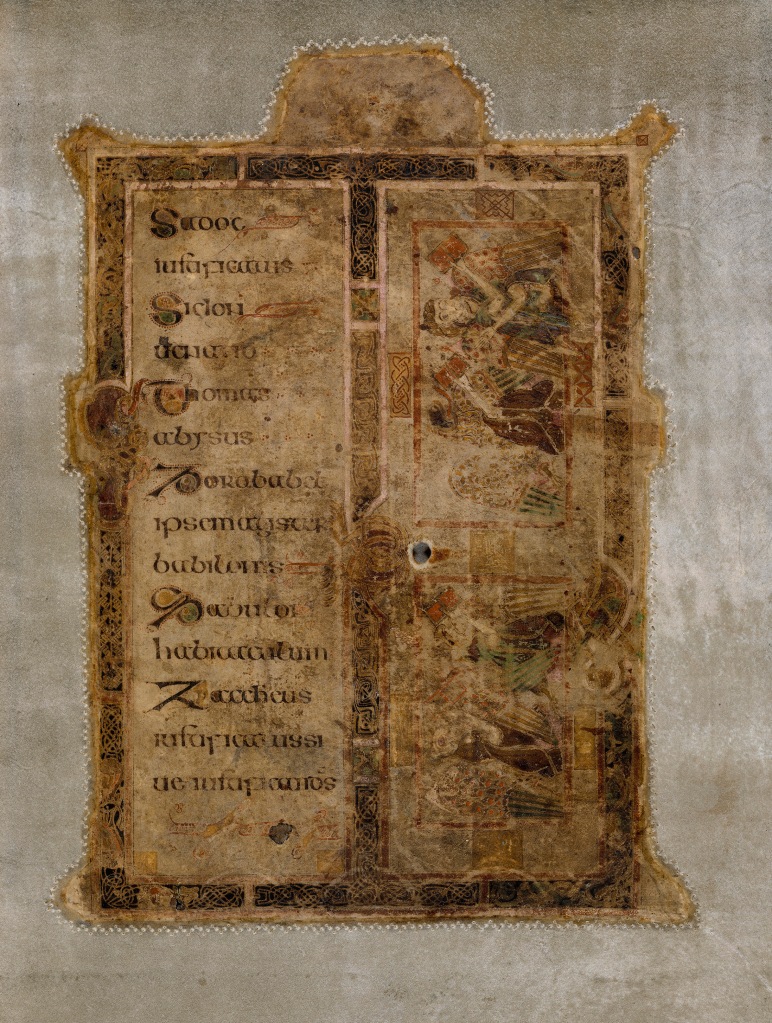
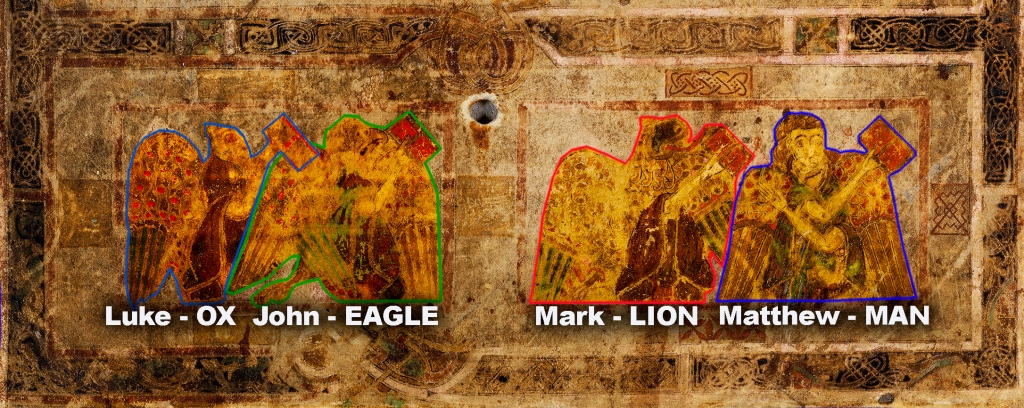
Folio 129v is a particularly unique design. The symbols of the evangelists appear in the circular frames within the quadrants. However, the symbols of St. John, St. Mark, and St. Luke appear secondarily inside the rectangular borders of each other’s quadrants. This artistic choice is curious as it breaks with the symmetry apparent in the other examples of the evangelist illuminations. (see previous post) For instance, the quadrant devoted to St. Matthew includes dual images of his symbol of Man. However, St. Mark’s quadrant includes the symbols of St. Luke and St. John in the lower portion of the frame. The following quadrant depicts St. Luke as the Ox with the symbol of St. John and a second illumination of the evangelical symbol of St. Luke in the upper region of the frame. Finally, the quadrant devoted to St. John again includes the symbols of St. Mark and St. Luke below, with the border of the frame partially obscuring their lower bodies and limbs.

Further punctuating this departure from the book’s meticulous design and symmetry are the pronounced errors occurring in the border base at the bottom of the page. On close examination, it is apparent that the inverted “T” in the lower region of the frame has arms of unequal length, disturbing the central balance of the entire illumination. Directly below this, the small, central ornamental design is shifted slightly to the right, rather than mirroring the embellishments on the upper border of the page.

Another potential error occurs in St. Matthew’s quadrant. Here, the artist has filled in the upper portion of the frame with green ink, leaving the remainder of the background uncolored. The lack of additional background color does not seem to be an issue of fading or peeling. If we examine the recto side of the parchment, it is apparent that the only ink applied to the background of the quadrant is the solitary block of green that has seeped through the fibers of the vellum.
Folio 129v 
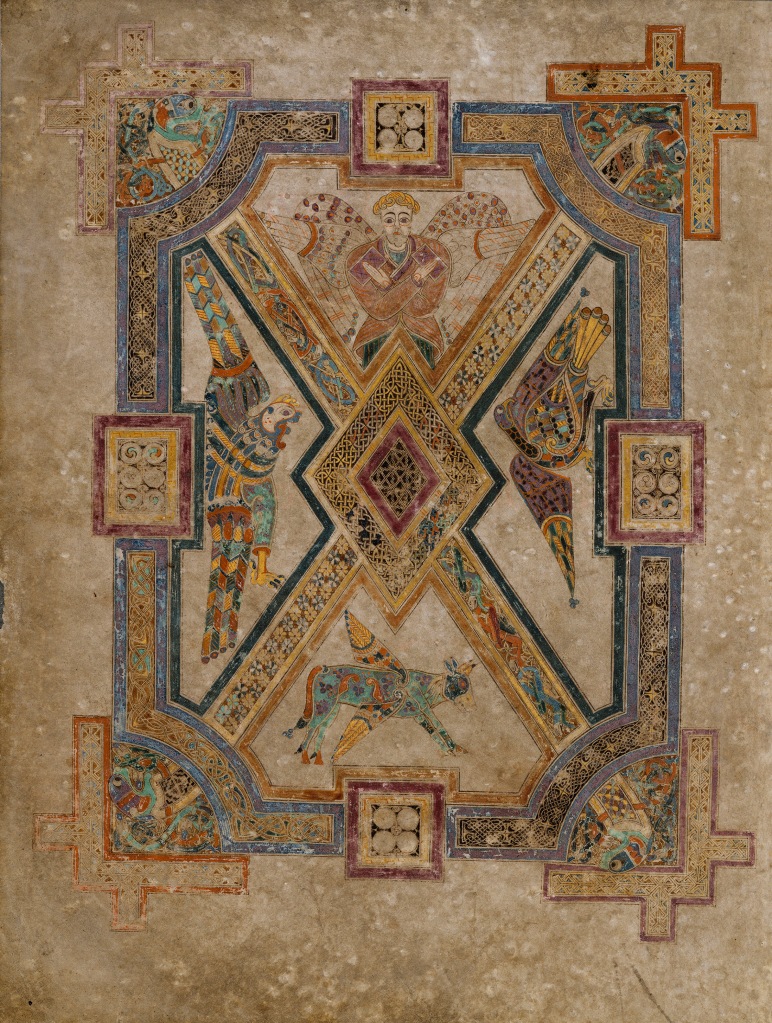
Folio 129r
Having said all this, we must remember that these monks were toiling long hours, with only the light of candles to guide their weary eyes. After all, to err is human, to forgive divine.

 Scribes & Storytellers