Archaeological evidence has noted that merchants brought commodities such as tin and amber to Ireland in the first millennium BCE., suggesting extensive trade routes that connected Ireland to neighboring Britain and the faraway lands bordering the Baltic Sea. Long-established links between Britain and Armorica (modern-day France) trace back to the third millennium B.C. where a broad trade network connected the two territories. In roughly the same period, the Romans established the Amber Road linking Northern and Southern Europe to the Balkans. These prehistoric trade routes were vital to the connection between the remote island of Ireland and continental Europe.
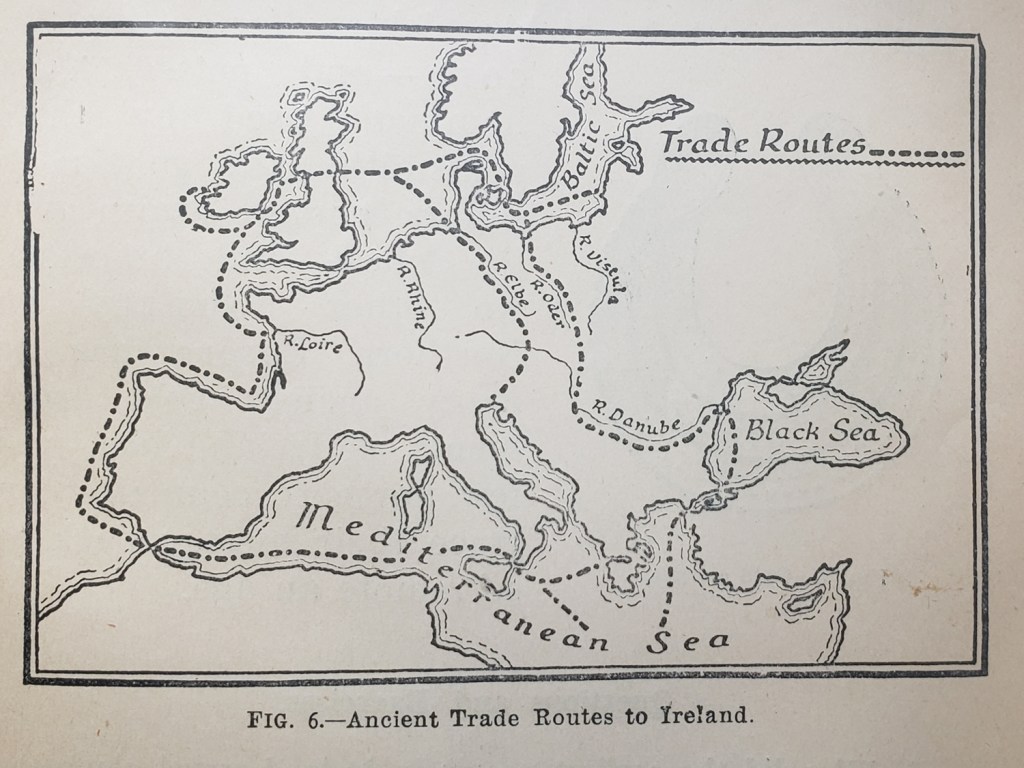
Ancient Trade Routes to Ireland, Classic Book of Irish History, Parkgate Printing Works, Dublin, Ireland, 1945
One such route extended from the tin mines in southwest Britain, over the English Channel into France, continuing down to the Mediterranean Basin. Exotic artifacts such as amber, gold, and coral discovered at ancient hillforts along this thoroughfare, suggests that these sites served as trading posts. Commerce flowed in both directions along this route resulting in exchanges of technologies, artwork, and ideas alongside material goods.
These essential trade routes crossed religious, cultural, and political boundaries, helping shape the iconography of Insular art in the early medieval period.
Sources:
De Navarro, J.M., “Prehistoric Routes between Northern Europe and Italy Defined by the Amber Trade”, The Geographical Journal, Vol. 66, No. 6 (December 1925), pp. 481–503.
Muhly, J.D, Copper and Tin: the Distribution of Mineral Resources and the Nature of the Metals Trade in the Bronze Age, Hamden: Archon Books, (1973).
 Scribes & Storytellers