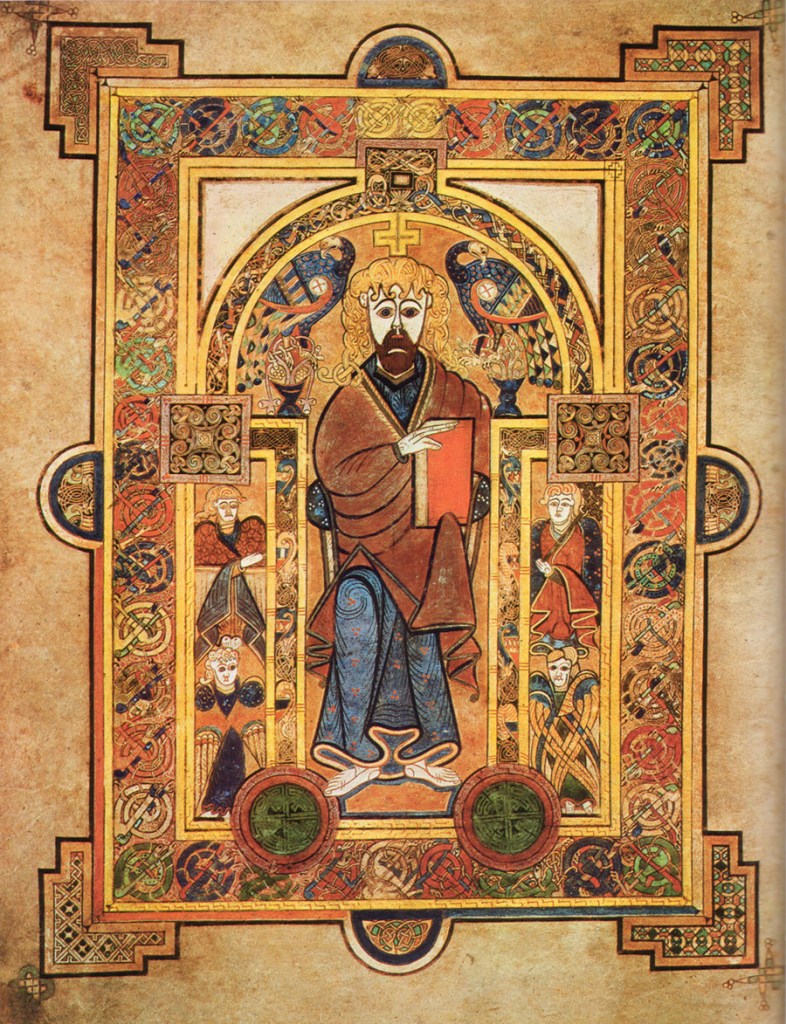
Spiritual Significance of Color in Early Christian Art

In early Christian art, the symbolic meaning of color was significant for expressing the characteristics of the portrayed figures. As an essential element in iconography, each color represented specific traits or properties attributed to the depicted icons and elements. These notions of symbolic colors were widely used but not inflexible. Often artists rendered their interpretations of the canons of iconography, resulting in representations that varied according to region, culture, and period.

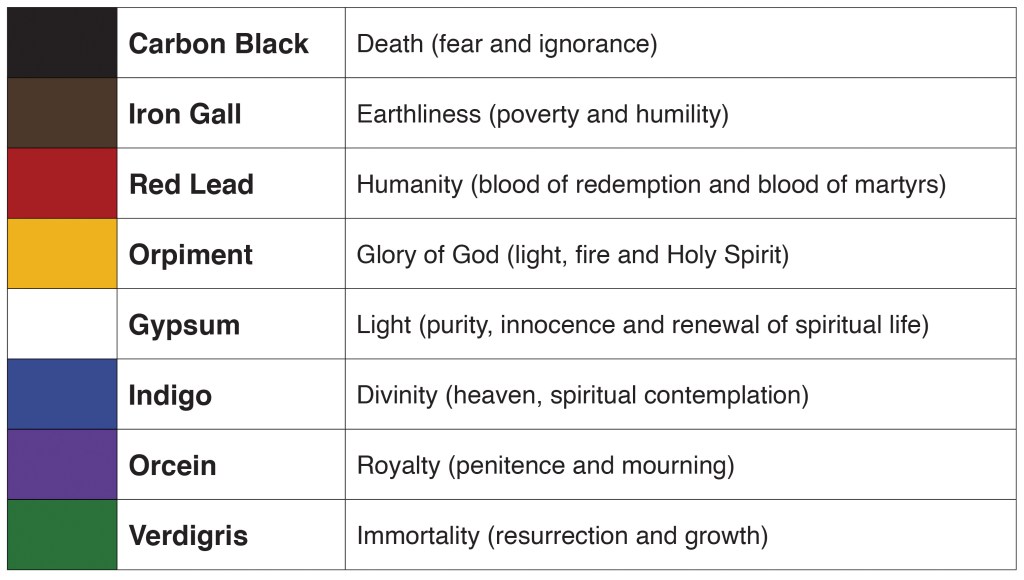
In the Book of Kells, for example, eight-core pigments have been identified. Below is a chart listing the pigments with their corresponding iconographic values.
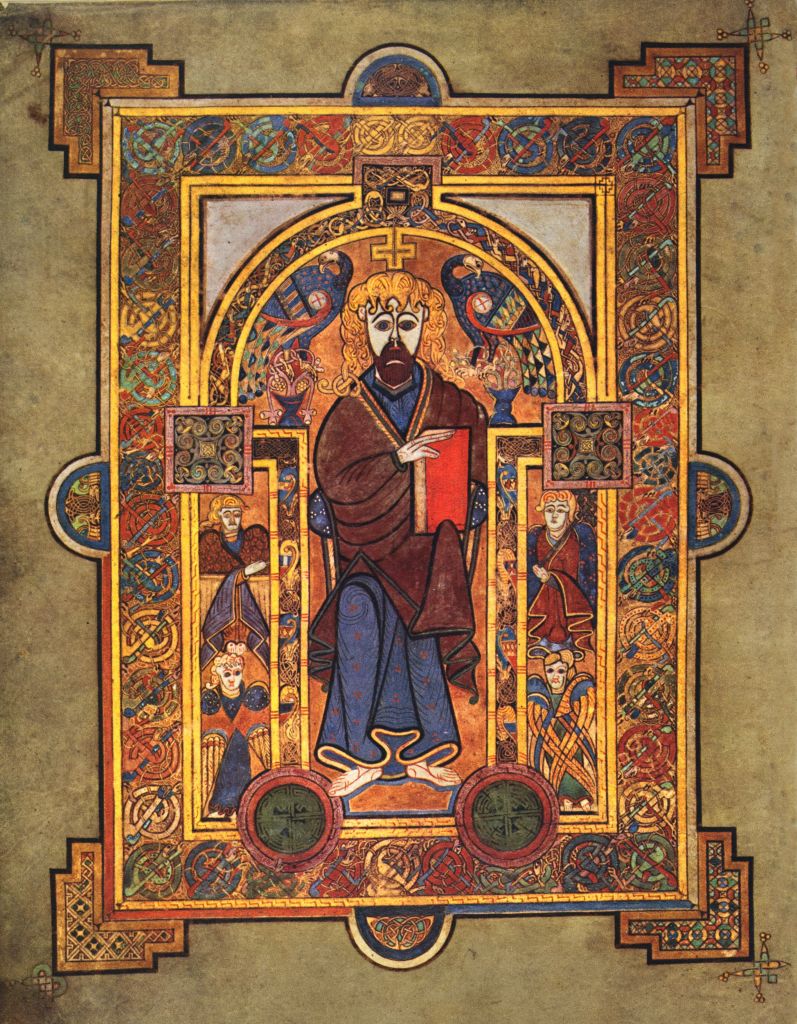
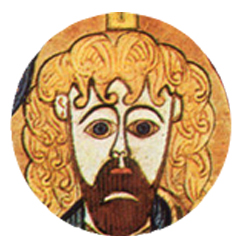
It is interesting to question the intent of the artisans of the Book of Kells while taking note of the varied use of the tenets of color symbolism in these two images of Christ. Here, the artists chose to depict Christ with fair hair and a reddish-brown beard.
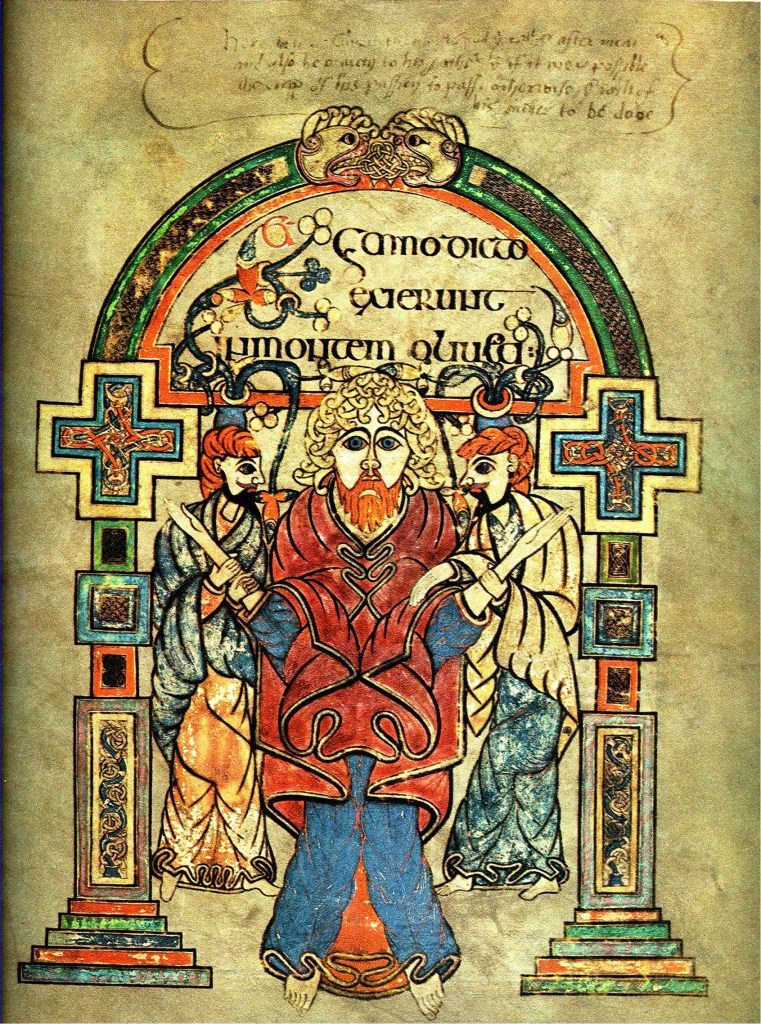
One way to begin a potential analysis of this artistic choice is to examine the texts these images illustrate. Both of these images appear in the Gospel of Matthew, whose opening line in the Vulgate reads:

Liber generationis Jesu Christi filii David, filii Abraham. (The book of the generation of Jesus Christ, the son of David, son of Abraham.)

Matthew 1:1

1 Samuel 17:42 describes David as having reddish hair, so perhaps the auburn beard of Christ references Matthew’s assertions of Christ’s adoptive lineage to David through Joseph. Nevertheless, this does not explain the fair hair on his head. There are no physical descriptions of Jesus in the Gospels; however, in Matthew 17:23, the transfiguration of Christ provides the following description:

et transfiguratus est ante eos. Et resplenduit facies ejus sicut sol (and he was transfigured before them. And his face shone as the sun)

Matthew 17:23

Perhaps then, the golden yellow hair of Christ in the Book of Kells is symbolic of the Glory of God, therefore, representing the duality of Christ’s human and divine incarnations. As we can see, His costume consists of a blue tunic with a red robe which further signifies His divinity and humanity.

However, for this analysis to be considered a viable resolution, Christ would need to be the only figure in the book depicted with these traits, consistently discerning Him from any other persons. Further investigation of the illuminations is necessary for constructing this argument.

Sources:

“The Book of Kells.” The Book of Kells – The Library of Trinity College Dublin – Trinity College Dublin. Accessed April 22, 2021. https://www.tcd.ie/library/manuscripts/book-of-kells.php. https://doi.org/10.48495/hm50tr726

“Internet Sacred Text Archive Home.” Internet Sacred Text Archive Home. Accessed April 22, 2021. https://sacred-texts.com/bib/vul/index.htm.
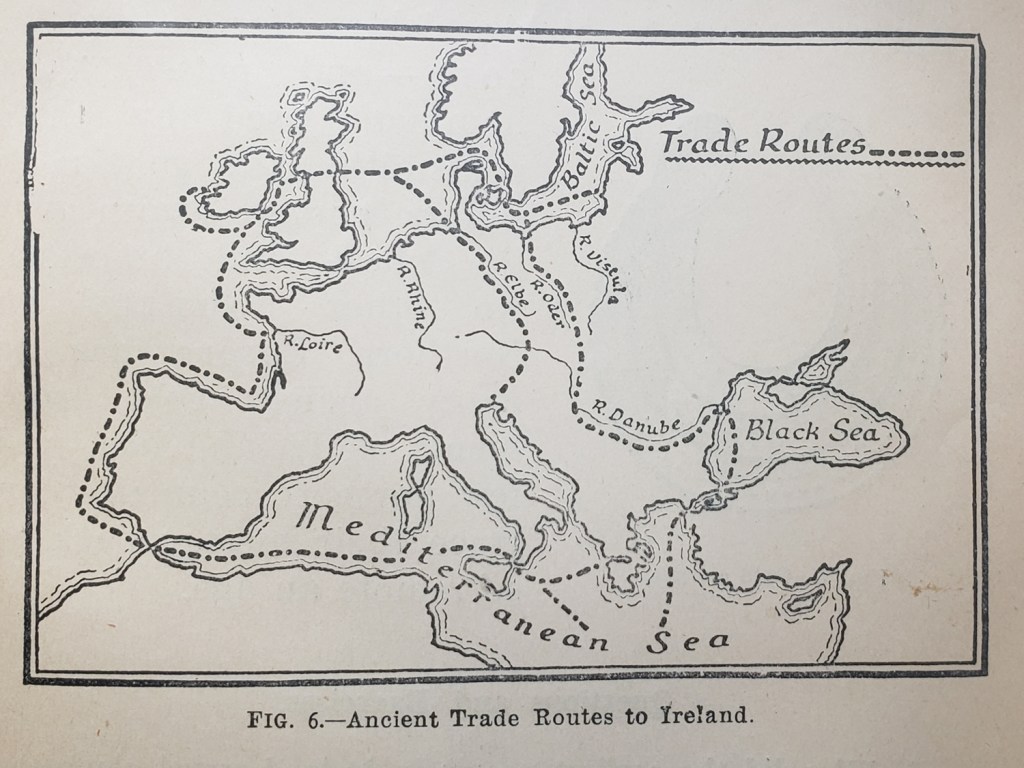
Ancient Irish Trade Routes

Archaeological evidence has noted that merchants brought commodities such as tin and amber to Ireland in the first millennium BCE., suggesting extensive trade routes that connected Ireland to neighboring Britain and the faraway lands bordering the Baltic Sea. Long-established links between Britain and Armorica (modern-day France) trace back to the third millennium B.C. where a broad trade network connected the two territories. In roughly the same period, the Romans established the Amber Road linking Northern and Southern Europe to the Balkans. These prehistoric trade routes were vital to the connection between the remote island of Ireland and continental Europe.

One such route extended from the tin mines in southwest Britain, over the English Channel into France, continuing down to the Mediterranean Basin. Exotic artifacts such as amber, gold, and coral discovered at ancient hillforts along this thoroughfare, suggests that these sites served as trading posts. Commerce flowed in both directions along this route resulting in exchanges of technologies, artwork, and ideas alongside material goods.

These essential trade routes crossed religious, cultural, and political boundaries, helping shape the iconography of Insular art in the early medieval period.

Sources:

De Navarro, J.M., “Prehistoric Routes between Northern Europe and Italy Defined by the Amber Trade”, The Geographical Journal, Vol. 66, No. 6 (December 1925), pp. 481–503.

Muhly, J.D, Copper and Tin: the Distribution of Mineral Resources and the Nature of the Metals Trade in the Bronze Age, Hamden: Archon Books, (1973).

Coptic Connection

The connection between the iconographic styles of Coptic and Celtic art extends beyond the scrollwork so readily identifiable, particularly in the Insular manuscripts. Composition and figural representations also bear considerable similarities.

Early Coptic Christian icons are discernible by indicative features such as sharp outlines, flat colors, simplified shapes delineating folds in fabric and facial features, without concern for realism. One of the most prominent features of the style was the eyes of the figures portrayed. The eyes are large and do not seem to gaze upon the viewers but beyond and past them. This deliberate artistic choice is symbolic and carries a meaningful divine message, as do many other aspects of the facial features in Coptic iconography. For example, the eyes were rendered large and with simplistic shapes to symbolize the ability to look beyond the material world to transcend into the light of God. Similarly, the artists diminished the nose and mouth to deemphasize sensuality and ill words while enlarging the ears to emphasize the importance of listening to the word of God. (1)

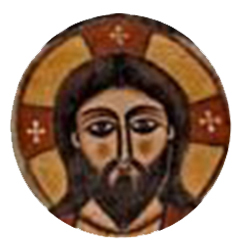
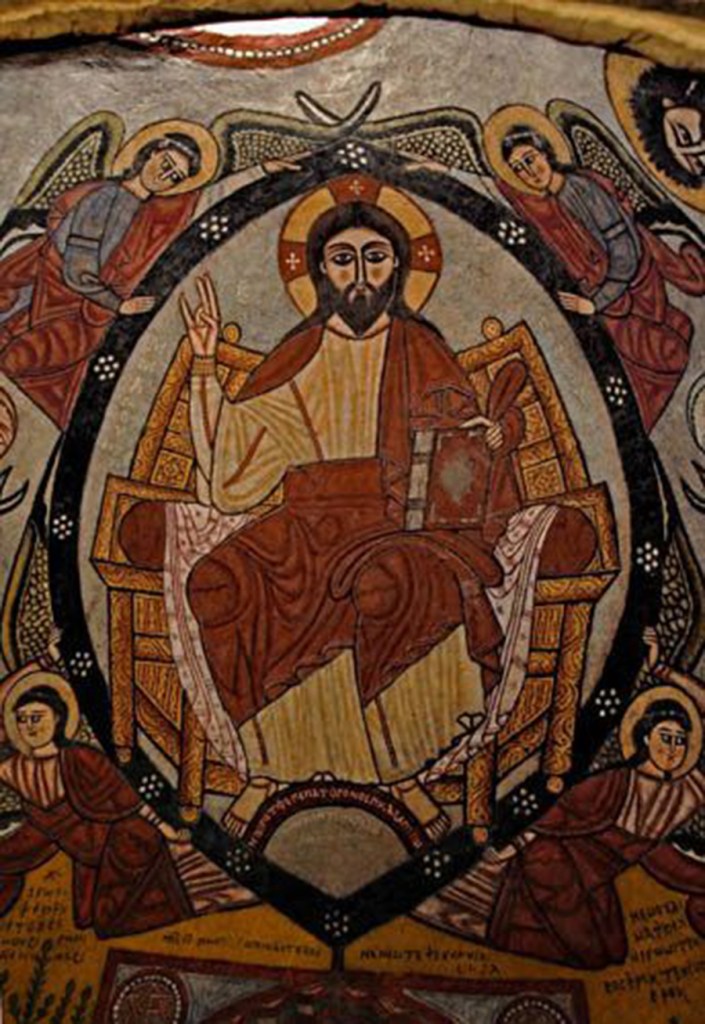
Many of these characteristics appear in images outside of the Coptic Church. Indeed they can be found in the Book of Kells (early 9th-century) illuminations. Although the imagery in the Book of Kells has become somewhat more ornate, the facial attributes in the figures seem to emulate the Coptic traditions of form. For example, the face of Christ in folio 32v from the Book of Kells bears a striking resemblance to the visage of Christ in the 7th-century wall painting from St. Antony’s Monastery in the eastern Sahara Desert of Egypt.

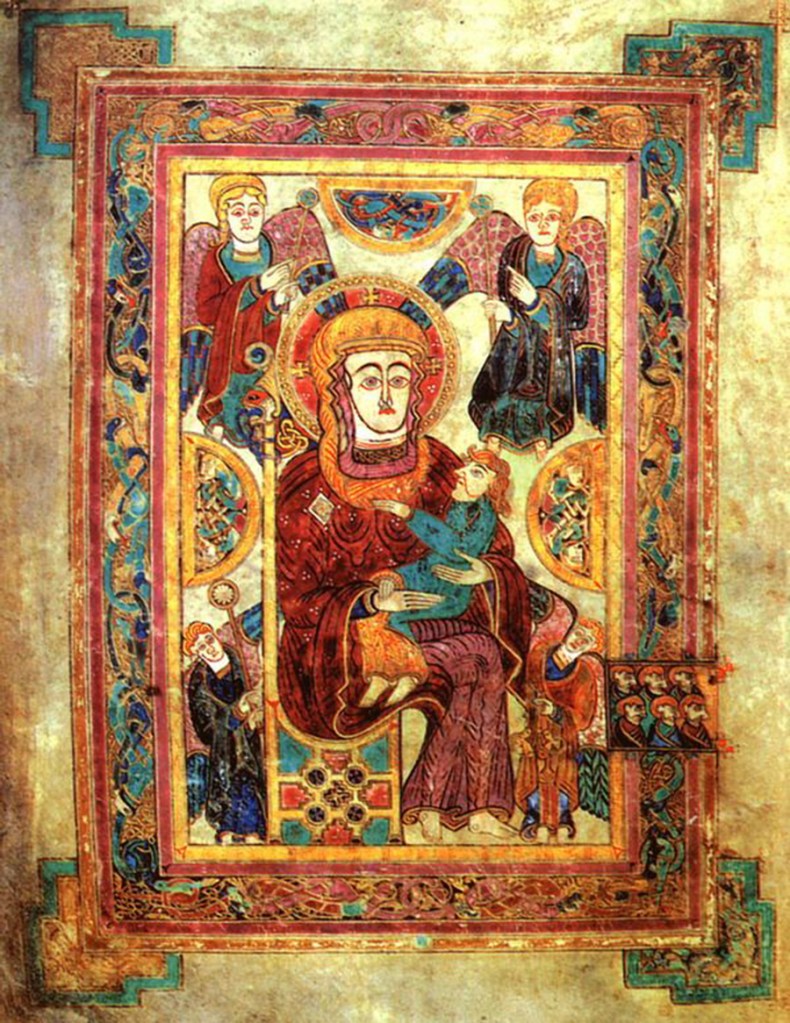
These examples also seem to be following in Coptic traditions of composition. Below, the central figure of Christ from the Egyptian wall painting is enthroned and surrounded by four angels. Likewise is the illumination of the Madonna from the Book of Kells (folio 7v). In this comparison, the Coptic Christ is presented as “Pantokrator”—holding the new testament in his left hand while making a gesture of blessing or teaching with his right. The angels flanking him represent the Seraphim and Cherubim, who praise Him as the incarnation of God. Thus, these angels also flank the Madonna and Child to emphasize that the divine child in the Virgin’s lap is Christ the Lord. (2)

The image of Christ enthroned from the Book of Kells is also a curious interpretation of Christ as Pantokrator. Here Christ holds the Bible in His left hand, but although He presents His right hand in a gesture of blessing, it is placed upon the book rather than held up toward the viewer. Perhaps this is to signify the sanctification of the word of God or to bless the sacred Book of Kells itself.

The similarities between the Christian imagery from these geographically disparate lands are compelling. So how did these iconographic ideas reach the distant shores of Ireland?

(1) Capuani, Massimo, and Otto Friedrich August. Meinardus. Christian Egypt: Coptic Art and Monuments through Two Millennia. Collegeville, MN: Liturgical Press, 2002.

(2) Sawires, Dr. Paula. “Coptic Iconography and Orthodox Theology.” Egyptian Christian Art (blog). Accessed March 3, 2021.