The origin of Celtic art in early Europe lay in merging several diverse styles into something unique and distinctive. Superimposed upon the indigenous Hallstatt decorative techniques (primarily a geometric style with contrasting colors and textures) was the art of the classical world of Graeco-Etruscan models, which made their way into the household of the Celtic chieftains by way of bronze artifacts acquired through trade.
A third influence came from the East, where a Persian style of animal art merged with Greek and Scythian art forms and migrated west, finding its way into the courts of the Celtic aristocracy. By the end of the 5th century, the merging of the three styles results in the earliest manifestation of a genuinely Celtic art known as the Early Strict Style.
By the 6th century in Ireland, the southern half of the country was more culturally progressive than the North, partly because of contact with Gaul, particularly with Aquitaine, where goods would be traded and brought back to Ireland. This relationship would continue through the following centuries with expanding exposure to artwork from farther reaches of the Christian world.
In the first millennium, the art of Ireland is an amalgamation of pagan Celtic themes and Christian iconography, which absorbed considerable influences from cultures as far away as Egypt. Coptic art greatly influenced later Christian art, particularly noticeable in the artwork of the Gospel books produced in England and Ireland beginning in the 8th century. Patterns of clawed birds among vine scrolls merged with animal shapes and interlaced lines of Celtic heritage, creating the images we now classify as distinctive medieval Irish art.
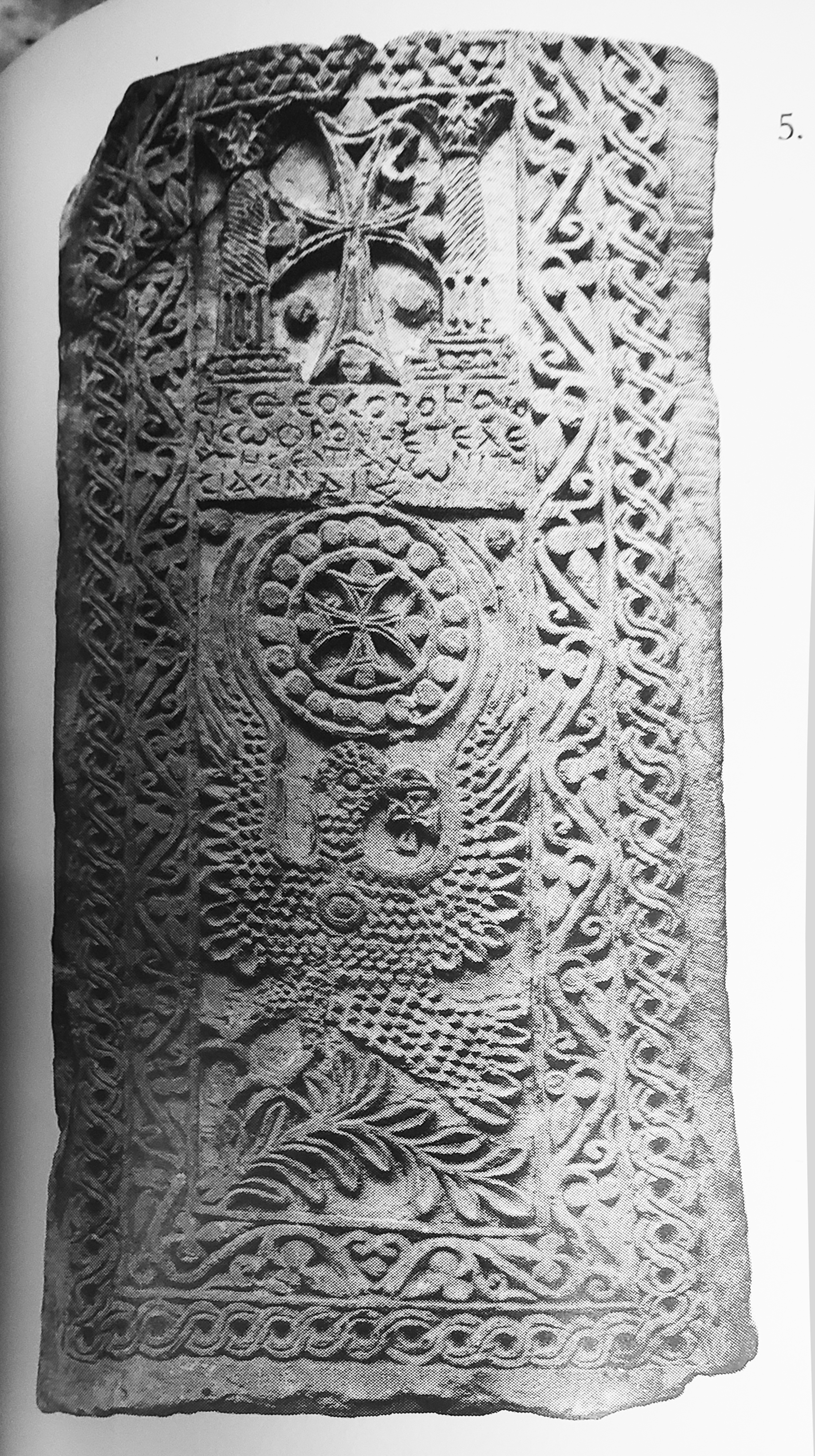
Coptic Tombstone, 7th century, Egypt,
Limestone, h. 2’8″, British Museum, London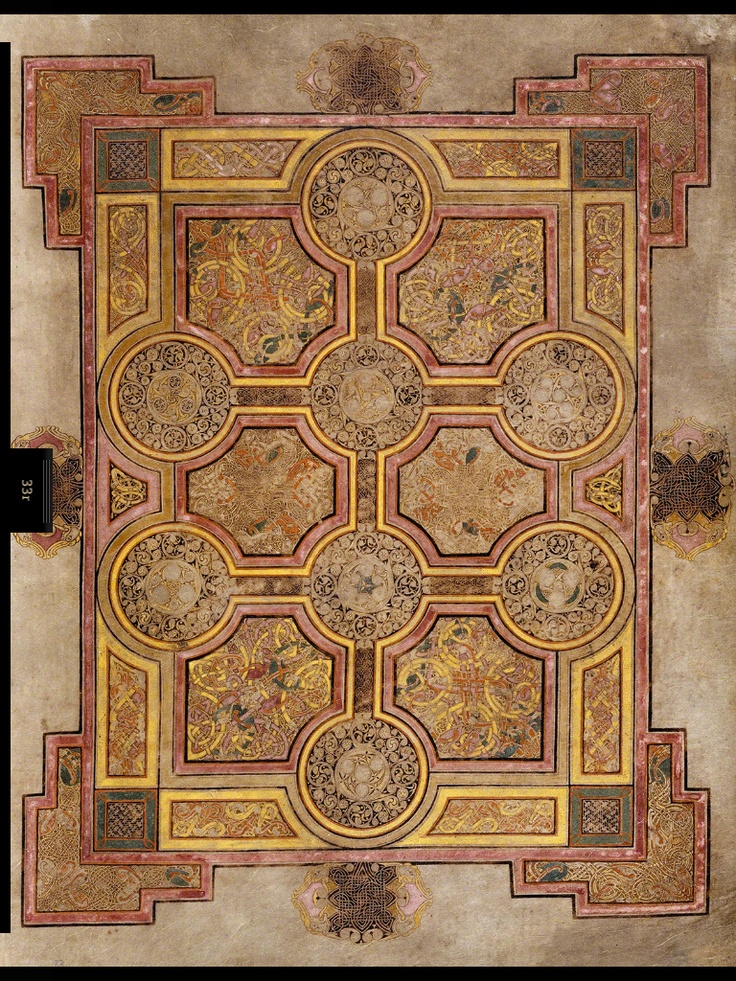
The Carpet Page, The Book of Kells, 9th century,
TCD MS 58, folio 33r © Trinity College Dublin.
In Sullivan, The Book of Kells, 1914.
Sources:
Munro, Eleanor C. The Encyclopedia of Art. New York, NY: Golden Press, 1965. Fourth Printing
Cunliffe, Barry W. The Celtic World. New York, NY: Greenwich House, 1986.
 Scribes & Storytellers