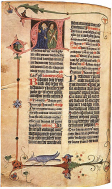
Artist unknown, 15th c., Gothic manuscript, France.
At the time that the Book of Kells was being created in Ireland, another style of illuminated manuscript was developing in continental Europe. This style was known as the Carolingian style and incorporated delicate pen-and-ink figures with a very literal interpretation of the passages of the Psalms. These manuscripts were literally illustrating the biblical stories in a truly narrative fashion.
By the 10th and 11th centuries, the older Anglo-Celtic style was abandoned in favor of the Carolingian style. Artists had become increasingly skilled at integrating illustration, decoration, and text. Although the traditional Celtic style was no longer in fashion, the cohesion of styles that culminated in the progression of the art of the illuminated texts still exhibited the Irish influence.
During the Gothic Age, 13th to 15th centuries, a more realistic style emerged. Figures were now rendered with accuracy and reflected the fashions and architecture of the era. However, the decorative elements still maintained an intricacy of pattern reminiscent of the ancient styles. ¹
¹ Christopher De Hamel, A History of Illuminated Manuscripts, Phaidon Press, London, England, UK, 1997, pages 92-107
 Scribes & Storytellers