The Four Evangelists

Of the imagery depicted in the Book of Kells, there are some interesting symbolic representations that were adopted from the Book of Revelation, to represent the four Evangelists. They are known as the four beasts of Ezekiel and are depicted as follows:
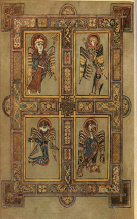
EVANGELISTS

Artist unknown, 800 A.D., Carpet page of the Four Evangelists from the “Book of Kells.”

The Lion – St. Mark – St. Mark is represented by this symbol due to the emphasis on Christ’s power and loyalty in the Gospel according to Mark.

The Eagle – St. John – St. John is represented by this symbol due to the belief that St. John, the Evangelist soared into Heaven and was able to “gaze upon the light of immutable truth with keen and undazzled eyes.”

The Ox – St. Luke – St. Luke is represented by this symbol due to the emphasis of Christ’s sacrifice in the Gospel according to Luke.

Man – St. Matthew – St. Matthew is represented by this symbol due to the emphasis of Christ’s humanity in the Gospel according to Matthew. (1)

The Book of Kells was intended to be more than just another manuscript of the Bible. To the Monks who created it, it was an homage to Christ and His message. The delicate care with which the carpet pages (2) were created is a testament to the passion and devotion of the artist.

(1) Ben Mackworth-Praed, The Book of Kells,
Studio Editions, Ltd., London, England, UK, 1993, pages 16-17. 14.

(2) Carpet Pages – pages of ornamentation typically placed at the beginning of each of the four Gospels in Gospel Books.

Book of Kells

The Book of Kells, written around 800 A.D., is a book of the four Gospels written and illustrated by monks and was named for the Irish midland monastery of Kells, Co. Meath. The astonishing intricacy of the illustrations in the Book of Kells is a combination of the traditional Celtic motifs and the influence of Saxon decoration brought back to Ireland by missionaries from abroad. Animal forms interlocked with geometric patterns gave birth to the complex intertwining designs that predominate Celtic art from this period forward.

The calligraphy and variety of illustrative styles suggest that several different artisans constructed the manuscript. Scholars, who have studied the manuscript closely, discern that there were several artists who created the animal illustrations and knotwork designs, and a separate portrait painter responsible for the human figures. It is also believed that many of these portraits that are included in the decorations of the pages are actually caricatures of local people. Additionally, there is evidence that there were numerous scribes involved in transcribing the text. It has been narrowed down to four distinctive calligraphic styles with the following attributes:

1. Scribe A – Unadorned calligraphy.

2. Scribe B – Unadorned calligraphy with different colored inks.

3. Scribe C – Limited use of decoration in combination with calligraphy.

4. Scribe D – Extensive use of decoration and script.

scribes

Many of the designs incorporated into the text served purposes beyond mere decoration. For example, there are a few instances where the foot of an animal serves as a hyphen and other examples where feet, tails, and flowers are used as punctuation marks. (1)


(1) The Book of Kells – The Work of Angels? , Kultur Video, West Long Branch, N.J., 2000