The Celts arrived in Ireland around 500 B.C. They were an Iron Age culture that archeologists believe originated in central Europe. The Celts were an intelligent race with a thirst for knowledge. These qualities enabled them to assimilate into and fuse with the races they conquered easily. In the early Middle Ages, the Irish Celts were amongst the most noteworthy pioneers in exploration, science, philosophy, and religion. Their legacy of learning is in part responsible for earning Ireland the moniker “The land of scholars and saints.”(1)
The Celts brought with them a primitive alphabet known as ogham.
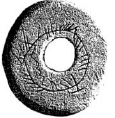
Photographer unknown, Date unknown, Inscribed spindle-whorl from Buckquoy, Orkney (Crown copyright: Institute of Geological Sciences, NERC)
This alphabet consisted of twenty characters, known as feda, which are separated into four categories, known as aicmi. A different carving in the stone or wood represents each aicmi. For example, the letters B, L, S, F, and N are represented by downward strokes, while the letters H, D, C, T, and Q are represented by upward strokes. The letters M, G, NG, Z, and R are represented by perpendicular strokes, and the vowels A, E, I, O and U are represented by notches. The angled strokes and notches cross a centerline forming a pattern reminiscent of the circular and spiral designs of the traditional art. (2)

Sheila Sturrock, 1997, “Celtic Knotwork Designs.”
The artistic expression and decoration of the Irish remained somewhat primitive until the arrival of the Celts. Early Celtic art introduced more sophisticated “Celtic Knotwork Designs.” geometric figurations based on circles, spirals, and curved lines. These advances in design culminated in the intricate knotwork that has become synonymous with Celtic art, an art form that would flourish into its “Golden Age” after the advent of St. Patrick and the Irish conversion to Christianity. (3)
- T.W. Rolleston, Celtic Myths and Legends, Studio Editions Ltd., London, England, UK, 1996, pages 35-39.
- Dr. Barry Fell, “The Ogam Scales from the Book of Ballymote,” ESOP Vol. 22 pgs. 87- 133, The Dawson Library, 1993.
- T.W. Rolleston, Celtic Myths and Legends, Studio Editions Ltd., London, England, UK, 1996, page 21.
 Scribes & Storytellers