Ireland’s Bronze Age dates from around 2000 B.C. until the arrival of the Celts in 500 B.C. During this time Irish art takes on a distinctive style. Ireland, being on the edge of Europe, was not as exposed to the influence of the Mediterranean as continental Europe was. As such, the artistic influences remained contained within the island’s own heritage. The Irish design styles in the Bronze Age period are very similar to the Neolithic patterns and motifs found in the stone carving of that period. There are examples of this on artifacts such as the Petrie Crown, which includes a variation of the triskele.
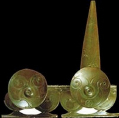
Photographer unknown, Date unknown, “Petrie Crown,” first century A.D.
During this period, bronze was used to manufacture many different items ranging from weapons to adornments. The Irish used clay molds to cast the bronze into different shapes. Several examples of flat axes and swords survive to this day. However, the largest collection of Bronze Age musical instruments hails from Ireland with a total of 104 horns and 48 bells.(1)
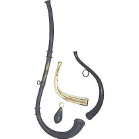
Photographer unknown, Date unknown, Bronze Age Horns
At this time, Ireland had a thriving goldsmith trade, and many ornamental objects found their way to Britain and continental Europe. Gold proved to be an ideal surface for embossing the intricate designs such as the concentric circles, hatched triangles and the spirals unique to the Irish artwork of the time. The craftsmen of this time became so adept at this technique that the complicated workmanship is nearly impossible to replicate today.
1. Seamus, Mac Annaidh, Irish History – Micropedia, Parragon, Bath, England, UK


 Scribes & Storytellers